

Why Command Center Operations Matter to Modern Enterprises
Command center operations are the 24/7 practice of gathering information, monitoring activity, coordinating people and resources, and directing the right response when something changes.
At their best, they give leaders one clear view of routine activity, emerging risks, and urgent incidents. A command center is more than a help desk or a room full of screens. It is the operational hub where incoming reports become decisions, and decisions become coordinated action.
For a commercial property, retail portfolio, or distributed operation, that can mean faster awareness of an alarm, a clearer response to a site issue, and better communication between on-site teams, vendors, and leadership.
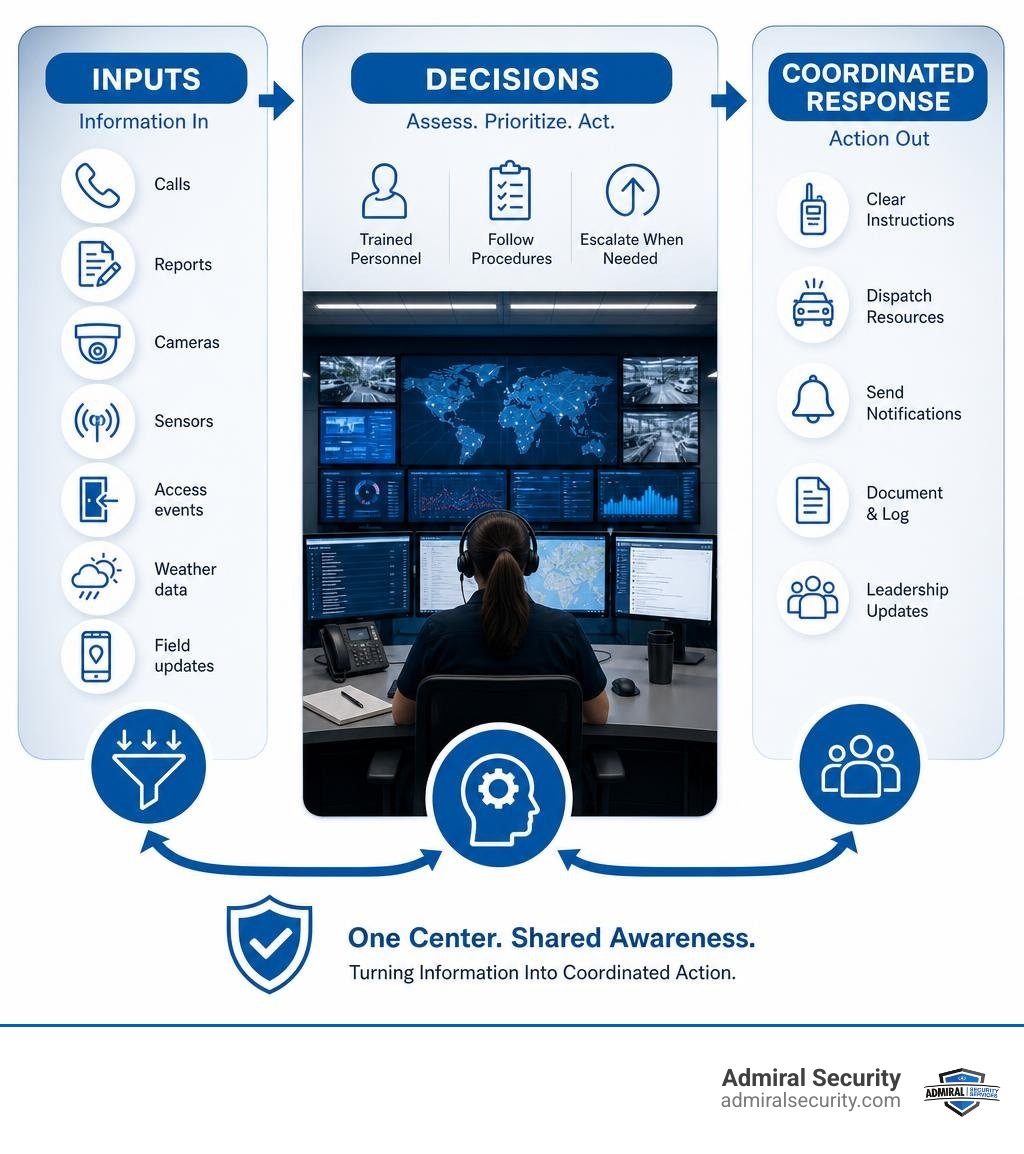
Modern command centers bring together:
- Inputs: calls, reports, cameras, sensors, access events, weather data, and field updates.
- Decision-making: trained personnel assess what matters, follow procedures, and escalate when needed.
- Outputs: clear instructions, dispatches, notifications, documentation, and leadership updates.
They operate during normal business conditions, not only during emergencies. When an incident grows, the same center can shift from routine monitoring to a focused, higher-tempo response.
Defining Command Center Operations: Core Principles vs War Rooms and Control Rooms
When I talk with property executives and facility managers across regions like Boston, Baltimore, and Houston, I often find that terms like “command center,” “control room,” and “war room” get blended together. While they share common technology and room designs, their core operational purposes differ significantly.
At its root, command center operations are grounded in standard Command and Control (C2) principles. The primary goal of a command center is to sustain operational continuity. It allows an enterprise or facility to execute daily functions without interruption, regardless of external disruptions.
The underlying engine of any command center relies on a continuous three-step cycle:
- Inputs: Receiving real-time updates, situation reports (sitreps), progress reports (progreps), environmental sensor alerts, and surveillance feeds.
- Processing: Analyzing raw information, checking data against operational thresholds, and using established frameworks to make clear decisions.
- Outputs: Issuing direct orders, dispatching field personnel, notifying senior executives, and updating tracking dashboards.
Command Center vs Control Room vs War Room
To understand how these environments function, it helps to break down their operational scope and life cycles.
A command center provides ongoing leadership, continuous operational oversight, and proactive risk guidance. A control room is usually a physical space where all monitoring or technical execution functions are consolidated into a single room. In contrast, a war room is established temporarily to resolve an acute strategic crisis, coordinate a temporary project, or execute a targeted campaign. Once the crisis ends or the goal is met, a war room disbands. A command center operates around the clock, year after year.
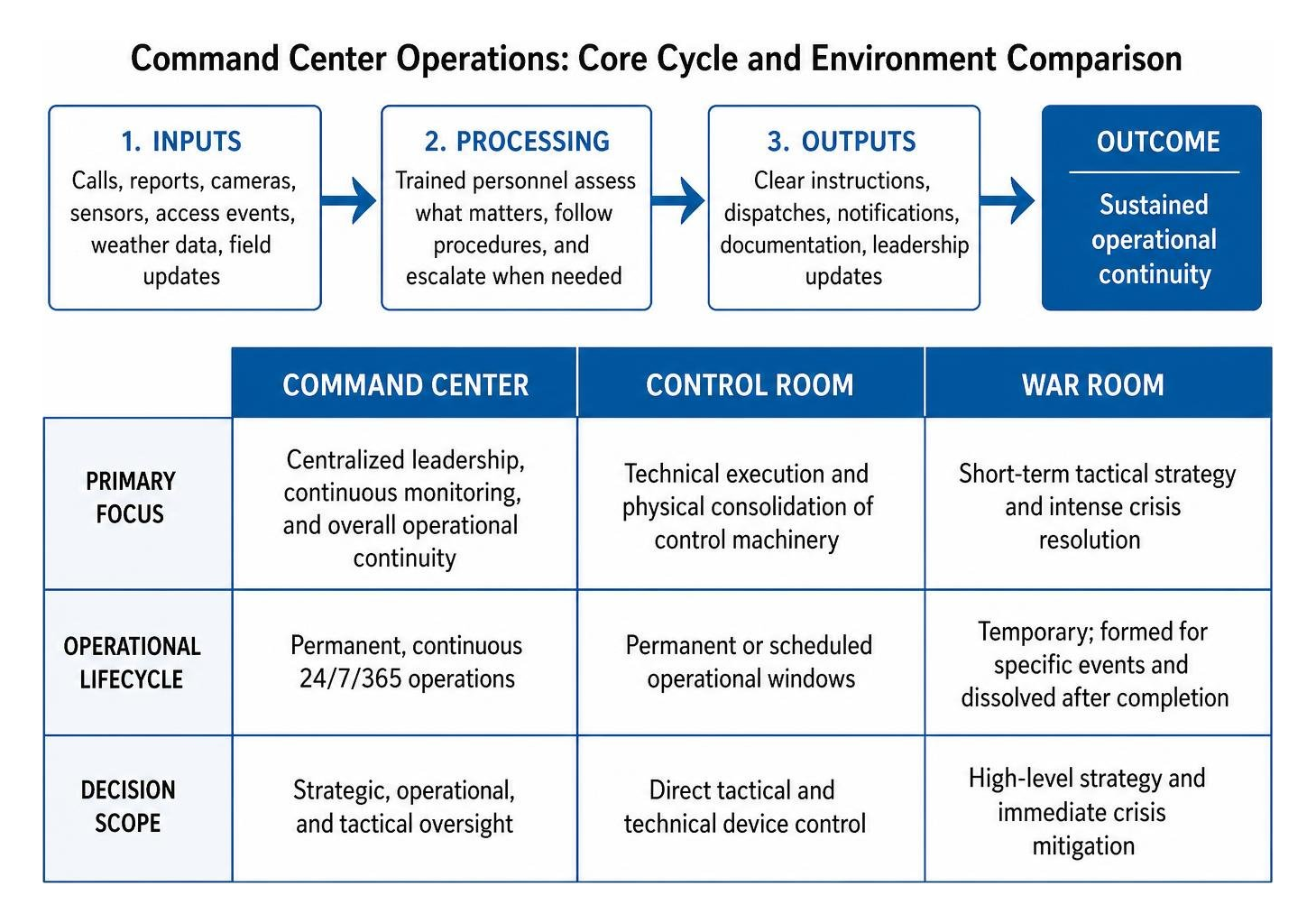
| Operational Attribute | Command Center | Control Room | War Room |
|---|---|---|---|
| Primary Focus | Centralized leadership, continuous monitoring, and overall operational continuity | Technical execution and physical consolidation of control machinery | Short-term tactical strategy and intense crisis resolution |
| Operational Lifecycle | Permanent, continuous 24/7/365 operations | Permanent or scheduled operational windows | Temporary; formed for specific events and dissolved after completion |
| Decision Scope | Strategic, operational, and tactical oversight | Direct tactical and technical device control | High-level strategy and immediate crisis mitigation |
| Primary Outputs | Resource allocation, operational directives, sitreps, dispatch commands | System toggles, active environmental management, device status logs | Strategic action plans, policy adjustments, immediate response directives |
Commercial and Enterprise Command Center Applications
While military history shaped early C2 structures, modern businesses depend on enterprise command centers every day. Commercial facilities employ Global Security Operations Centers (GSOCs) to oversee sprawling physical campuses, urban real estate portfolios, and multi-state logistics networks.
In high-density commercial markets like Dallas, Miami, and Raleigh, enterprise command center platforms manage field service teams, monitor facility health, track high-value assets, and enforce strict Service Level Agreements (SLAs). Through modern Integration Monitoring, a central desk can track active guard patrols, verify access control logs, monitor HVAC alarm states, and respond to site incidents in real time.
By centralizing data streams, businesses eliminate regional silos, maintain consistent security standards, and maintain rapid response capabilities across every property.
Organizational Hierarchy and Command Structures Across Sectors
To maintain clarity during chaos, every command center relies on a strict organizational structure. Whether managing military defense assets, public safety networks, or enterprise security infrastructure, transparent authority hierarchies prevent confusion and decision bottlenecks.
Guidance documents like COMMAND CENTER OPERATIONS, COMDTINST 3120.20B highlight how military frameworks structure authority across broad regions. In both government and enterprise settings, command structures establish who leads, who supports, and how authority escalates when situations grow complex.
Tiered Command Hierarchies (National, Area, District, Sector)
In multi-tiered organizational models, operations are divided into distinct jurisdictional tiers:
- National Level: Focuses on high-level strategic situational awareness, agency-wide resource balancing, and continuous communication with top executives and government leaders. The national tier maintains overall domain awareness but rarely directs individual tactical assets on the ground.
- Area Level: Coordinates mid-tier operational strategies across large geographical domains, such as Atlantic or Pacific regional zones. Area operations manage resource allocations across multiple sub-districts during extended events.
- District Level: Focuses on regional operational coordination. District hubs bridge the gap between high-level policy guidance and field operations, ensuring regional facilities maintain mutual aid capabilities.
- Sector Level: Serves as the primary tactical command hub. Sector units directly dispatch on-site teams, monitor immediate radio traffic, handle local incident calls, and track real-time field assets.
A key element in these structures is the explicit limit placed on delegation authority. In regulated military frameworks and corporate protocols alike, designated operational commanders cannot delegate primary command authority without formal written approval. If a lower-tier sector encounters a massive crisis or lacks local resources, operational authority and oversight dynamically scale up to the next higher command level.
Specialized Multi-Domain Command Facilities
Across defense, space, and aviation sectors, specialized operations hubs showcase how complex inputs integrate under tight timelines:
- The Cheyenne Mountain Complex – United States Nuclear Forces historically brought together missile warning systems, air defense centers, and space control units inside a underground facility designed to survive extreme conditions.
- The Combined Air Operations Center (CAOC) acts as a tactical nerve center that plans, directs, and monitors air combat sorties, surveillance assets, and strategic airlifts across expansive international operational theaters.
- NASA’s Spaceflight Operations – NASA framework manages real-time spaceflight control, crew safety monitoring, and worldwide communications across global networks.
These facilities demonstrate how separate disciplines, including trajectory design, environmental monitoring, cybersecurity, and logistics, sit under a single unified leadership umbrella.
Key Watch Positions and Staffing in 24/7 Command Center Operations
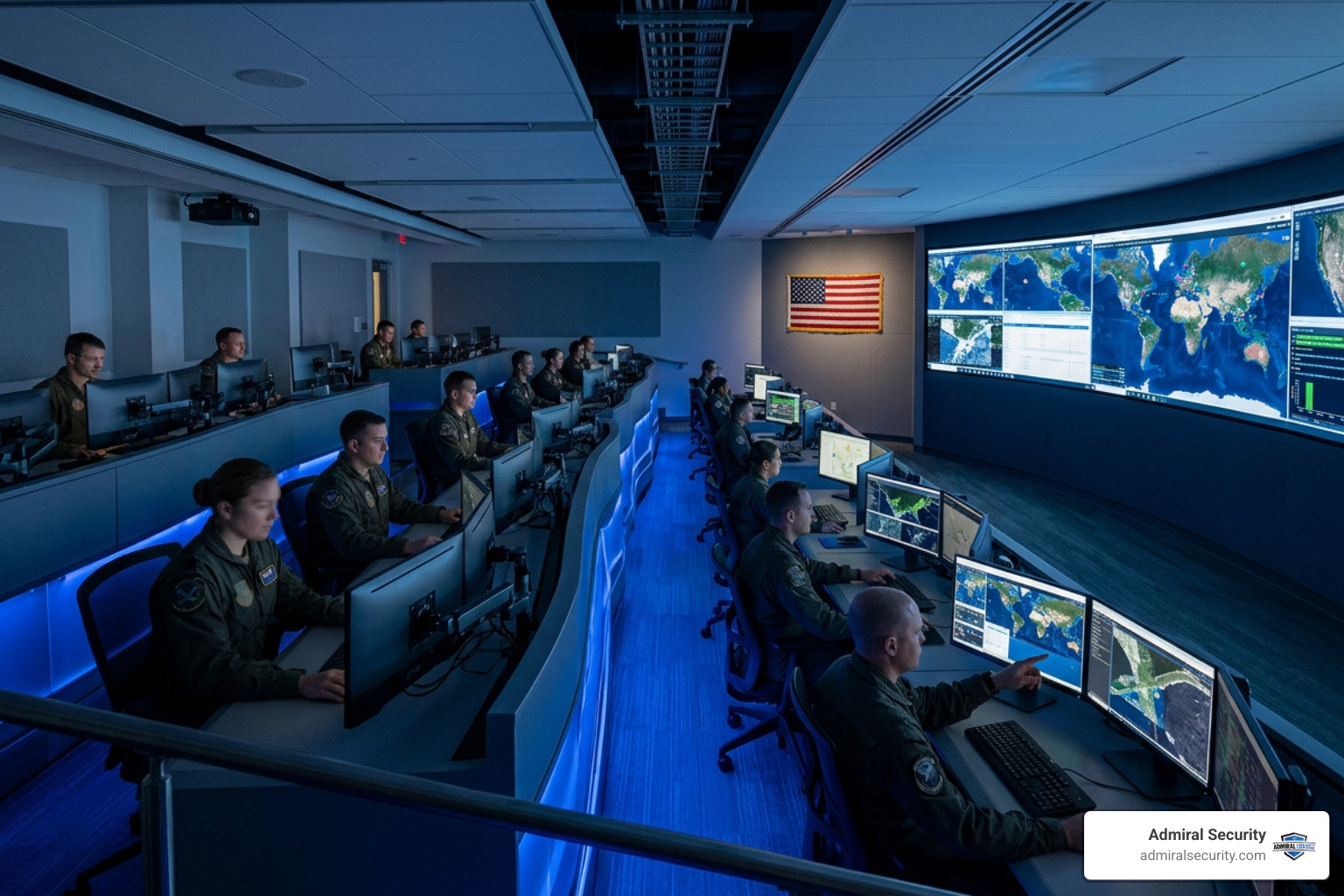
A command center is only as strong as the watchstanders who staff it. Maintaining a continuous 24/7 operational tempo requires structured shift rotations, standard roles, and disciplined fatigue management.
Roles and Responsibilities of Watchstanders
To maintain continuous awareness without overlapping duties, watchstanding teams divide responsibilities into clearly defined operational roles:
- Command Duty Officer (CDO): The direct representative of the operational commander. The CDO holds full operational authority during their watch shift to make immediate decisions, execute emergency action plans, and authorize resource dispatches.
- Operations Unit (OU): The tactical execution arm of the watch floor. The OU directly coordinates active field incidents, dispatches patrol assets, communicates with local first responders, and manages tactical radio channels.
- Situation Unit (SU): The intelligence and tracking core. The SU maintains the Common Operational Picture (COP), tracks geographic resource locations, analyzes incoming risk reports, and creates official situation reports (sitreps).
- Communications Unit (CU): Manages technical communications architecture. The CU ensures continuous connectivity across radio frequencies, phone lines, satellite terminals, and secure digital networks.
- Functional Area Representatives (FARs): Subject matter experts embedded during major incidents. FARs offer direct guidance on specialized domains such as cybersecurity, facility engineering, legal compliance, or corporate communications.
Crew Endurance, Watchkeeping Policies, and Fatigue Management
Human operator performance drops sharply when exhaustion sets in. In high-stakes monitoring environments, fatigue leads to missed alerts, slow decision-making, and communication breakdowns.
To prevent operator burnout, leading military and commercial standards establish strict work-rest balance rules. For instance, standard maritime watchkeeping rules enforce strict maximum caps:
- Watchstanders are generally restricted to no more than 84 watch hours within any 14-day rolling window for standard multi-shift rotation schedules.
- Extended 24-hour on-board watch positions enforce absolute caps of no more than 96 watch hours within a 14-day period, ensuring mandatory off-duty rest cycles.
Integrating structured endurance tracking into corporate security Risk Management frameworks ensures operators remain sharp, focused, and ready to respond during critical events.
Operational Challenges and Staffing Constraints in Command Center Operations
Managing continuous desk shifts creates ongoing administrative challenges. One major hurdle is the burden of collateral duties. When operators are tasked with administrative paperwork or side projects while monitoring live systems, their core situational awareness suffers.
Other continuous challenges include:
- Waiver Requirements: When staffing shortages occur, leaders are forced to issue formal policy waivers to extend operator shift limits, which can elevate operational risk if overused.
- Qualification Pipelines: Training a fully certified watch officer requires months of rigorous qualification programs. Turnover can create operational gaps if training pipelines fall behind.
- Burnout Mitigation: Monotonous monitoring interrupted by high-stress emergency alerts creates cognitive fatigue. Scheduled shift rotations, comfortable station ergonomics, and mandatory rest periods are essential.
By addressing these staffing constraints early, facility leadership can build realistic staffing schedules that support long-term operator health and retain experienced personnel, as outlined in The Ultimate Guide to Emergency Planning.
Technology Integration and Information Management for Crisis and Routine Readiness
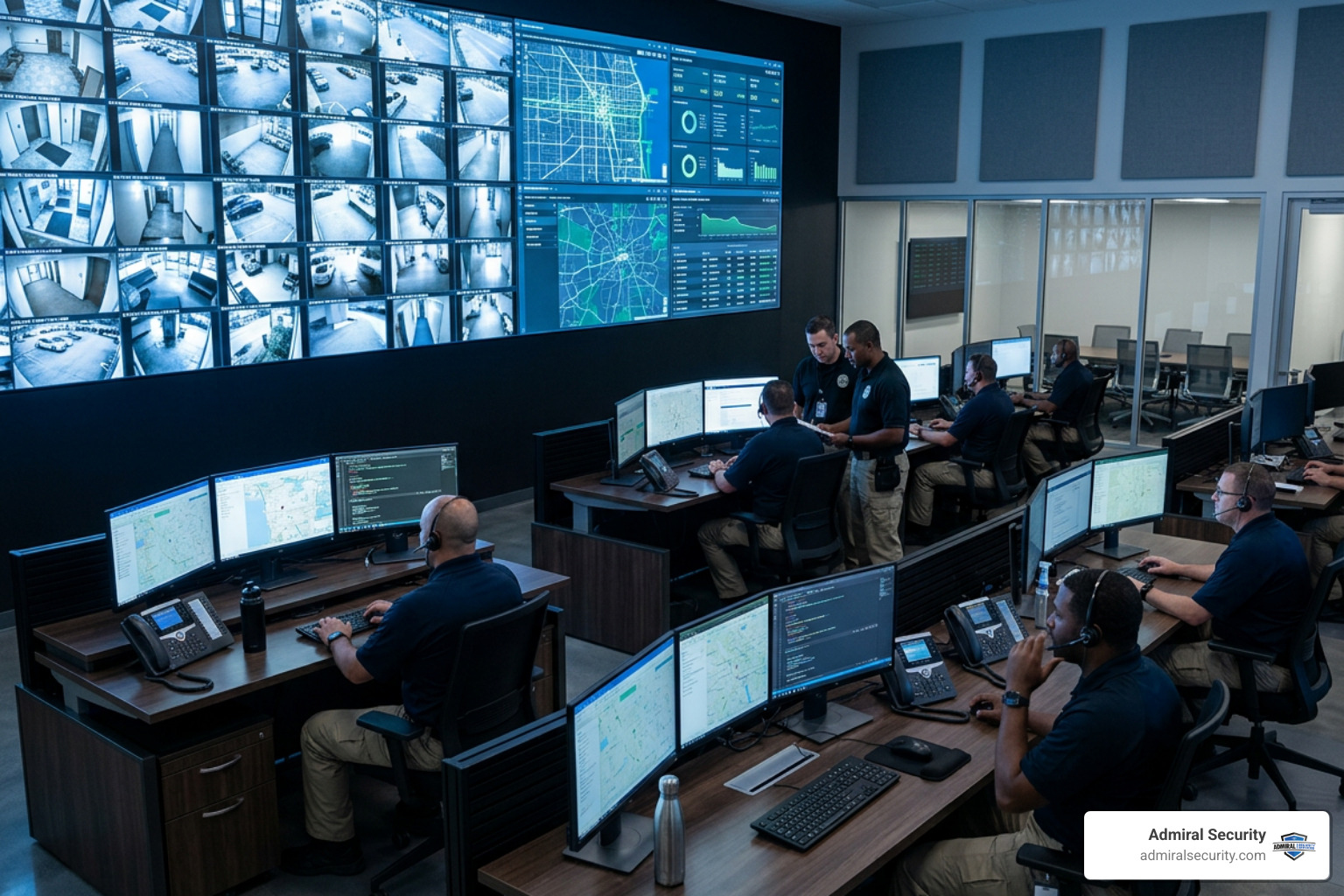
Modern command center operations rely on integrated hardware platforms, data networks, and software engines. These technologies transform incoming telemetry into actionable intelligence.
Technology Infrastructure and Systems Architecture
Building an enterprise command center requires integrating several core tech layers:
- Video Surveillance and Analytics: Display walls aggregate feeds across distributed properties. Systems process live video streams to highlight perimeter breaches, unauthorized access attempts, or vehicle hold-ups. Learn more about these solutions in The Complete Guide to Video Monitoring Options.
- Geographic Information Systems (GIS): Spatial tracking tools map field personnel, access control points, vehicle paths, and active site alarms over high-resolution geographic overlays.
- Access Control and Sensor Fusion: Centralized software platforms link card readers, environmental monitors, fire safety systems, and motion sensors directly to desk monitoring consoles. Explore these capabilities in our breakdown of modern enterprise Technology.
- Redundant Communication Systems: High-capacity fiber optics, local wireless networks, cellular data backups, and satellite transceivers ensure command desks stay connected even when local infrastructure fails.
Balancing Steady-State Routine and Emergency Escalation
A well-designed command center seamlessly transitions between normal daily operations and acute emergency conditions. Frameworks like Air Combat Command guidelines classify operational posture into clear response tiers:
- Level 3 (Steady-State): Standard operational tempo. Watchstanders monitor daily access points, log routine visitor calls, track scheduled guard patrols, and conduct standard system health checks.
- Level 2 (Surge): Activated during localized incidents, extreme weather warnings, or elevated risk environments. Staffing levels increase, non-essential administrative duties pause, and designated incident coordinators step in.
- Level 1 (Maximum Surge): Fully activated crisis posture. Dedicated Crisis Action Teams (CAT) mobilize, operations desks shift into emergency command protocols, and leadership takes direct operational control over multi-site incident responses.
When major operational disruptions occur, having established crisis postures ensures teams transition smoothly without confusion or lost time, as covered in Disaster Recovery 101 Because Hope Is Not a Cybersecurity Strategy.
U.S. Coast Guard Standards and Training Models for Operations
The standards used by public sector agencies offer a strong benchmark for commercial security excellence. Maritime regional centers, such as Sector Delaware Bay – Command and the broader United States Coast Guard Atlantic Area network, operate under strict, standardized operational guidelines.
Certification, Qualification, and Policy Compliance
To ensure every operator performs under pressure, military command environments rely on formal qualification pathways:
- Personnel Qualification Standards (PQS): Watchstanders must complete comprehensive PQS workbooks, demonstrate practical system mastery, pass written examinations, and clear formal oral qualification boards before assuming unsupervised watch duties.
- Standard Operating Procedures (SOPs): Units maintain clear, locally adapted SOPs that outline step-by-step actions for everything from routine radio checks to search and rescue dispatches.
- Compliance Audits: Independent inspection teams conduct regular operational audits to evaluate watchkeeping performance, verify software tracking logs, and confirm adherence to national policies.
By applying structured qualification frameworks and routine compliance checks, commercial enterprise command operations can achieve high reliability, consistent performance, and operational accountability.
Frequently Asked Questions About Command Center Operations
What is the primary difference between a command center and a war room?
A command center is a permanent, 24/7/365 operational hub designed to maintain continuous oversight, guide daily routines, and handle emerging incidents. A war room is a temporary space established specifically to resolve an acute strategic crisis, coordinate a targeted effort, or complete a specific campaign. Once the strategic issue is resolved, the war room disbands, whereas a command center operates continuously.
How do command centers maintain 24/7 operational readiness without operator fatigue?
Command centers manage operator fatigue by using structured shift rotation schedules, strictly enforcing work-rest policies, and limiting operational watch hours. High-standard frameworks restrict operators from exceeding strict watch limits within rolling 14-day periods. Additionally, modern centers focus on ergonomic workspace design, structured break schedules, and removing non-essential administrative tasks from active watchstanders.
What key technologies are required to run an effective modern command center?
An effective command center integrates several core technologies:
- Geographic Information Systems (GIS) for spatial visualization of field assets and incidents.
- Video surveillance platforms equipped with automated computer vision analytics.
- Access control systems and integrated sensor platforms.
- Common Operational Picture (COP) software that consolidates real-time data into a single visual dashboard.
- Redundant communications networks, including radio, internet, cellular, and satellite backups.
Enterprise Resilience Through Command Excellence
Establishing robust command center operations provides modern enterprises with the situational awareness needed to address risks, streamline operations, and defend commercial assets. By centralizing incoming communication streams, applying structured operational standards, and integrating modern monitoring tech, organizations create a proactive response environment.
At Admiral Security, I take pride in delivering comprehensive security solutions that blend trained uniformed personnel, advanced tech integration, and tailored security risk management across regions including Bethesda, Richmond, Tampa, and Austin. Our approach is built on responsiveness, logic, and empathy, ensuring your facilities remain operational, compliant, and well-managed around the clock.
To learn how integrated monitoring and central command strategies can strengthen your property management operations, explore our dedicated solutions at Integration Monitoring.