

How to Find Top Security Services That Fit Your Budget
I compare top security services by the risk they address: trained officers and access control for a site, managed cybersecurity for digital systems, and consulting for security planning. Then I check coverage hours, response times, staff training, technology fit, and total contract cost. The right choice meets your needs without charging for services you will not use.
For a commercial property or retail site, I would start with reliable staffing and clear response standards. A low price matters less if coverage falls short when the site needs it.
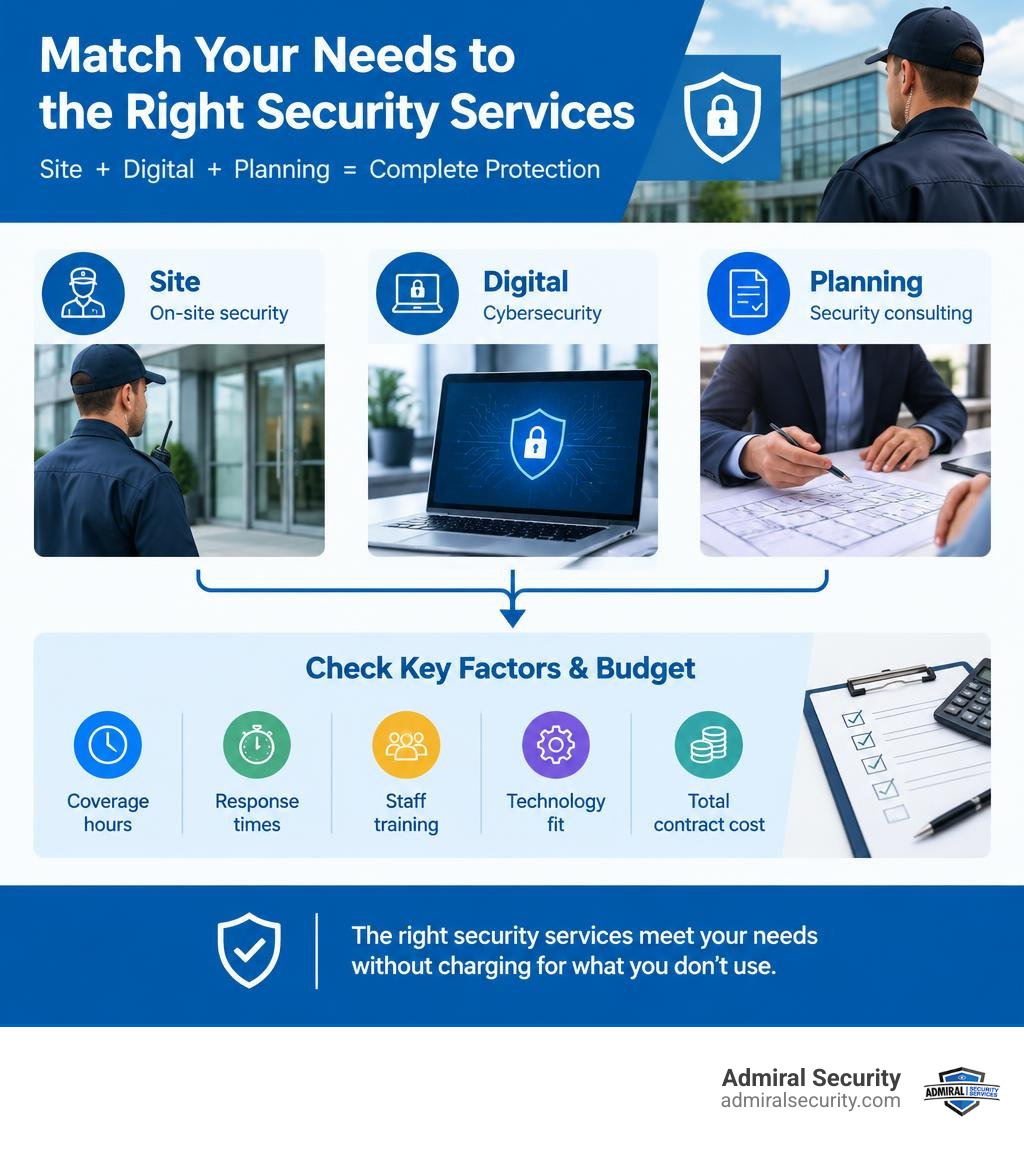
Quick top security services terms:
Top Security Services in 2026: Types and Comparison Criteria
When I evaluate providers, I separate them into physical security, managed cybersecurity, and consulting. Each category targets distinct vulnerabilities. Choosing the wrong service model wastes money and leaves critical vulnerabilities exposed.
Physical security addresses tangible assets, facilities, employees, and visitors. This includes uniformed personnel, static guard posts, access control management, and mobile patrols. On-site staff verify credentials, monitor physical entries, deter unauthorized access, and respond immediately to disturbances.
Managed cybersecurity handles digital systems, corporate networks, cloud infrastructure, and endpoints. A Managed Security Service Provider (MSSP) or Managed Detection and Response (MDR) firm manages firewalls, detects intrusions, and responds to digital threats.
Security consulting focuses on strategy, compliance audits, threat modeling, and security risk management. Consultants assess site vulnerabilities, design incident response plans, and guide teams through regulatory frameworks.
| Service Category | Primary Focus | Core Capabilities | Typical Cost Drivers |
|---|---|---|---|
| Physical Security | Site access, staff safety, physical assets | Uniformed officers, access control, patrols, visitor logging | Dedicated staffing hours, site coverage scope, post requirements |
| Managed Cybersecurity | Digital networks, cloud assets, endpoints | 24/7 SOC monitoring, MDR, threat intelligence, firewall management | Endpoints, log volume, monthly per-user subscriptions |
| Security Consulting | Strategy, compliance, audits | Vulnerability assessments, SOC 2/ISO roadmaps, penetration testing | Project scope, audit complexity, professional day rates |
Navigating industry standards helps define expectations. For digital operations, the 2026 MSSP industry benchmark highlights leading cybersecurity providers across global markets. For comprehensive facilities coverage, reviewing our security services overview clarifies operational standards. Following the ASIS Publishes New Guideline for Selection and Training of Private Security Officers ensures your on-site personnel meet strict vetting and performance benchmarks.
How 2026 rankings and ratings can guide your shortlist
Industry reviews provide valuable benchmarks during your initial search. In the cybersecurity space, customer satisfaction averages 94% likelihood to recommend and 97% professionalism across major platforms. However, high scores alone do not tell the whole story.
I look at several specific ranking signals:
- Review Volume vs. Recency: A 5.0 score based on 10 reviews is less informative than a 4.6 score across 80 or more verified client reviews. Look for feedback submitted within the current year.
- Analyst Recognition vs. User Scores: Portals like managed security service reviews show verified enterprise feedback, while market research reports measure global delivery scale.
- Operational Strengths: Check whether high ratings stem from day-to-day administrative ease or proven responsiveness during live incidents.
- Communication Clarity: The most frequent client complaint across security firms is jargon-filled, technical reporting that executive teams cannot interpret. Look for providers praised for clear, actionable communication.
How to Compare Top Security Services Without Breaking the Budget
Finding cost-effective security requires matching services directly to verified risks. Buying excess capacity strains budgets, but under-investing invites liability.

I use a structured evaluation method:
- Conduct a site or systems risk assessment to identify true vulnerabilities.
- Define mandatory service hours, distinguishing continuous 24/7 coverage from business-hours monitoring.
- Verify staff screening, training standards, and management oversight.
- Review technology integration capabilities, such as visitor tracking or surveillance systems.
- Check our regional guide on comparing security services in Tampa to align regional pricing and service levels.
Which top security services fit your budget and risk level?
Security pricing models vary across physical and digital sectors:
- Subscription and Per-User Pricing: Managed digital security typically bills monthly, running from $20 to over $150 per user each month depending on depth, such as basic firewall management versus advanced MDR with penetration testing.
- Hourly Staffing Rates: Physical security relies on billable guard hours. Standard uniformed personnel rates reflect training, supervision, licensing, and insurance.
- Flat Project Fees: Security risk assessments, penetration tests, and compliance audits generally use fixed project pricing.
When budgeting for major commercial hubs, review our guide on security services in Houston to plan around real-world market costs. Avoid hidden expenses by verifying setup fees, software licensing, retesting charges, and overtime billing terms up front.
How do top security services compare with in-house teams?
Building an in-house security department requires substantial capital. You must handle recruiting, continuous training, benefits, management overhead, and liability insurance.
For 24/7 on-site or digital coverage, an in-house team requires at least four to five full-time employees to manage shifts, sick leave, and vacations. Outsourcing provides immediate scale, established management frameworks, and predictable operational costs.
| Evaluation Factor | In-House Security Team | Outsourced Security Provider |
|---|---|---|
| Initial Investment | High (recruitment, onboarding, tooling) | Low (defined setup or transition fees) |
| 24/7 Operating Cost | High (salaries, overtime, benefits, relief staff) | Predictable (contracted hourly or monthly rate) |
| Management Burden | Internal leadership manages daily scheduling and training | Provider handles supervision, relief staffing, and training |
| Scalability | Slow (requires new hiring cycles) | Fast (adjust staffing schedules or licensing tiers) |
| Operational Focus | Dedicated entirely to your organizational culture | Broad expertise across varied operational environments |
What should buyers check before signing?
Before executing a service contract, I verify critical operational terms through our trusted provider selection process:
- Named Account Leadership: Ensure you have dedicated account managers and field supervisors rather than an anonymous help desk.
- Defined Response Times: Contractual Service Level Agreements (SLAs) must state guaranteed response times based on incident severity.
- Staffed vs. Automated Coverage: Confirm whether after-hours monitoring involves live, active monitoring or automated alerts forwarded to an unmonitored queue.
- Reporting Standards: Request a redacted sample report to ensure data is clear, concise, and useful for decision-makers.
- Exit and Transition Terms: Clarify data ownership, log retention terms, hardware transition protocols, and contract termination notice periods.
Which top security services fit your industry and locations?
Every facility and industry faces distinct regulatory and physical environments. A residential property requires a different posture than a hospital or financial institution.

Commercial properties, hospitality venues, and residential communities need strong customer-facing professionalism. Discover how specialized coverage works in our resource on security services for hotels and gated communities.
How do top security services fit healthcare, finance, and government?
Regulated sectors must align operational procedures with mandatory compliance frameworks:
- Healthcare Facilities: Must maintain patient privacy under HIPAA while ensuring open, welcoming access for patients and emergency responders. Security personnel manage visitor registration, control maternity and pharmacy access, and assist with disruptive individuals.
- Financial Institutions: Require strict access controls to meet PCI DSS and financial audit rules. Physical guards manage cash delivery zones, enforce badge access at data centers, and monitor administrative offices.
- Government and Public Sector: Demand strict adherence to compliance standards, background clearances, and data handling protocols. Providers must deliver transparent operational logs and reliable on-site personnel.
Our teams deliver specialized services across our regional operating hubs, including Bethesda, MD, Baltimore, MD, Newport, DE, Richmond, VA, Virginia Beach, VA, Lynchburg, VA, Roanoke, VA, Raleigh, NC, Greensboro, NC, Miami, FL, Melbourne, FL, Orlando, FL, Tampa, FL, Sunrise, FL, Houston, TX, Dallas, TX, Austin, TX, and Boston, MA.
How can physical security and cybersecurity work together?
Physical security and digital security converge in modern facility management. Breaches often exploit gaps between physical access points and digital infrastructure.
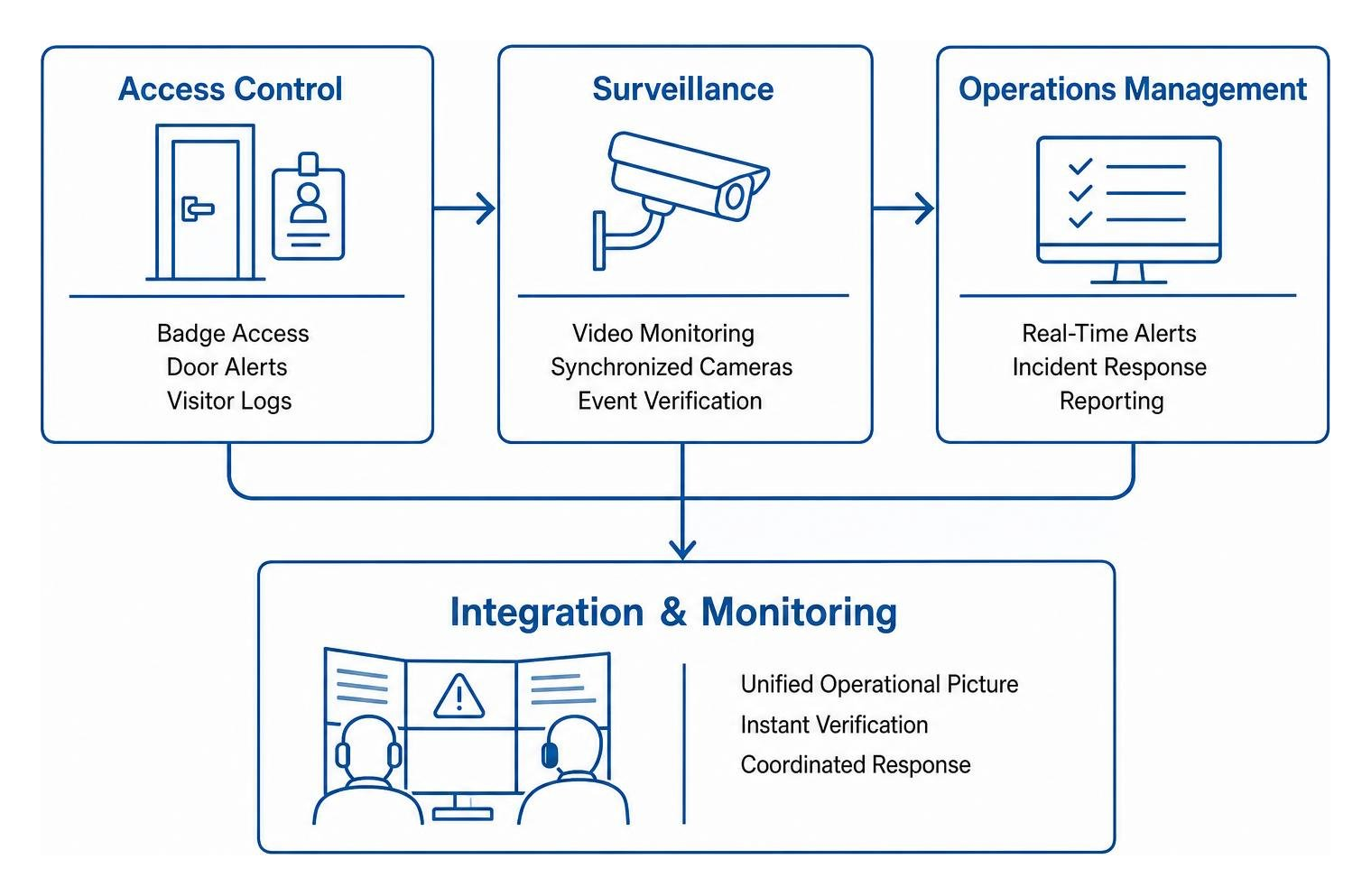
Physical officers support digital security by monitoring server rooms, validating vendor credentials, and preventing tailgating. Modern facilities leverage security technology alongside trained personnel.
Connecting electronic access control, visitor logs, and video surveillance with integration and monitoring creates a unified operational picture. When a badge alert triggers at a secure server room door, synchronized cameras and on-site officers can verify the situation instantly.
How Security Providers Differ by Delivery Model
Understanding the differences between operational delivery models ensures you buy the exact service your organization needs.
Organizations evaluating digital security frequently encounter three acronyms: MSSP, MDR, and cybersecurity consultancy. Each serves a distinct operational purpose, coordinated through overall security risk management.
MSSP, MDR, or consultancy: which model suits a mid-market company?
An MSSP manages infrastructure, firewalls, and continuous monitoring tools. They focus on maintaining operational uptime, updating configurations, and alerting you when issues arise.
An MDR provider focuses on threat detection, deep threat hunting, and active response. Rather than forwarding raw alerts, an MDR team investigates anomalies, verifies threats, and takes containment actions directly on affected systems.
A cybersecurity consultancy delivers point-in-time advisory services. They conduct penetration tests, assess compliance readiness, and build policies, but do not manage daily operations.
Mid-market organizations with existing IT staff often see the best value in an MDR service or a hybrid MSSP that handles alert validation. If your primary challenge is basic IT hygiene and configuration, an MSSP is ideal. If you need audit readiness or risk roadmaps, hire a consultancy.
Which provider features, pricing terms, and compliance support matter?
When negotiating digital or physical security agreements, prioritize these essential elements:
- True 24/7 Operations: Ensure personnel or monitoring centers are actively staffed around the clock, not just placing alerts on hold until morning.
- Integrated Management: Look for systems that integrate cleanly with your existing communication and incident management platforms.
- Audit and Compliance Support: Verify that the provider provides structured evidence logs for SOC 2, ISO 27001, or industry-specific audits.
- Transparent Service Scope: Ensure agreements specify whether incident response, remediation support, and retesting are included in base fees or billed as extra hourly charges.
For physical facilities, pairing these technological safeguards with professional uniformed personnel provides visible deterrence and rapid incident response across all properties.
Frequently Asked Questions About Top Security Services
What are the most common complaints or hiring pitfalls?
The most common issue is a mismatch between client expectations and contract scope. Clients often assume providers handle active remediation or post-incident repairs, only to find the contract covers basic monitoring.
Other frequent pitfalls include high guard turnover, unreadable technical reports, surprise invoices for standard incident investigations, and slow response times caused by unstaffed overnight shifts. Clear, written SLAs prevent these misunderstandings.
How can an organization test provider responsiveness before signing?
Ask prospective providers for documented incident timelines and redacted post-incident reviews from current accounts. During reference calls with existing clients, ask specifically about communication clarity during unexpected emergencies and after-hours events.
You can also request a simulated escalation test during contract negotiations to evaluate response times, communication channels, and the expertise of assigned account managers.
Should a company outsource security or build an in-house team?
For most organizations, outsourcing delivers superior coverage at a lower total cost. Outsourcing eliminates the overhead of round-the-clock shift scheduling, specialized ongoing training, management administration, and benefits.
A hybrid model is often effective for larger facilities. Under this structure, an internal security director manages policy, while an outsourced provider supplies trained officers, mobile patrols, and continuous systems monitoring.
Conclusion
Finding the right security partner requires a balanced assessment of your site requirements, digital risks, and available budget. Prioritize providers that offer transparent pricing models, proven staff training, reliable technology integration, and clear response commitments.
Admiral Security provides comprehensive security solutions, including trained officers, uniformed personnel, access control, security risk management, and technology integration. Our operations are built around the Admiral Advantage of authenticity, logic, and empathy, delivering responsive support and exceptional client experiences across all service locations.
Contact our team today to request a security consultation tailored to your facility and operational needs.