

How to Find the Right Security Guard for Hire
To find a security guard for hire, I would start with the site, not the price. List the hours you need covered, the entrances officers will manage, and the tasks they must handle. Clearly defining operational duties helps identify whether your facility requires customer service hospitality, dedicated access management, or active foot patrols. Then ask each provider how it verifies training and credentials, supervises officers, and responds when coverage changes. Compare written quotes using the same schedule and duties so you can see what each price includes.
For a commercial property or retail site, I would also look for officers who communicate well and represent the business professionally. The lowest quote may not be the best value if it leaves key duties, supervisory oversight, or backup staffing unclear.
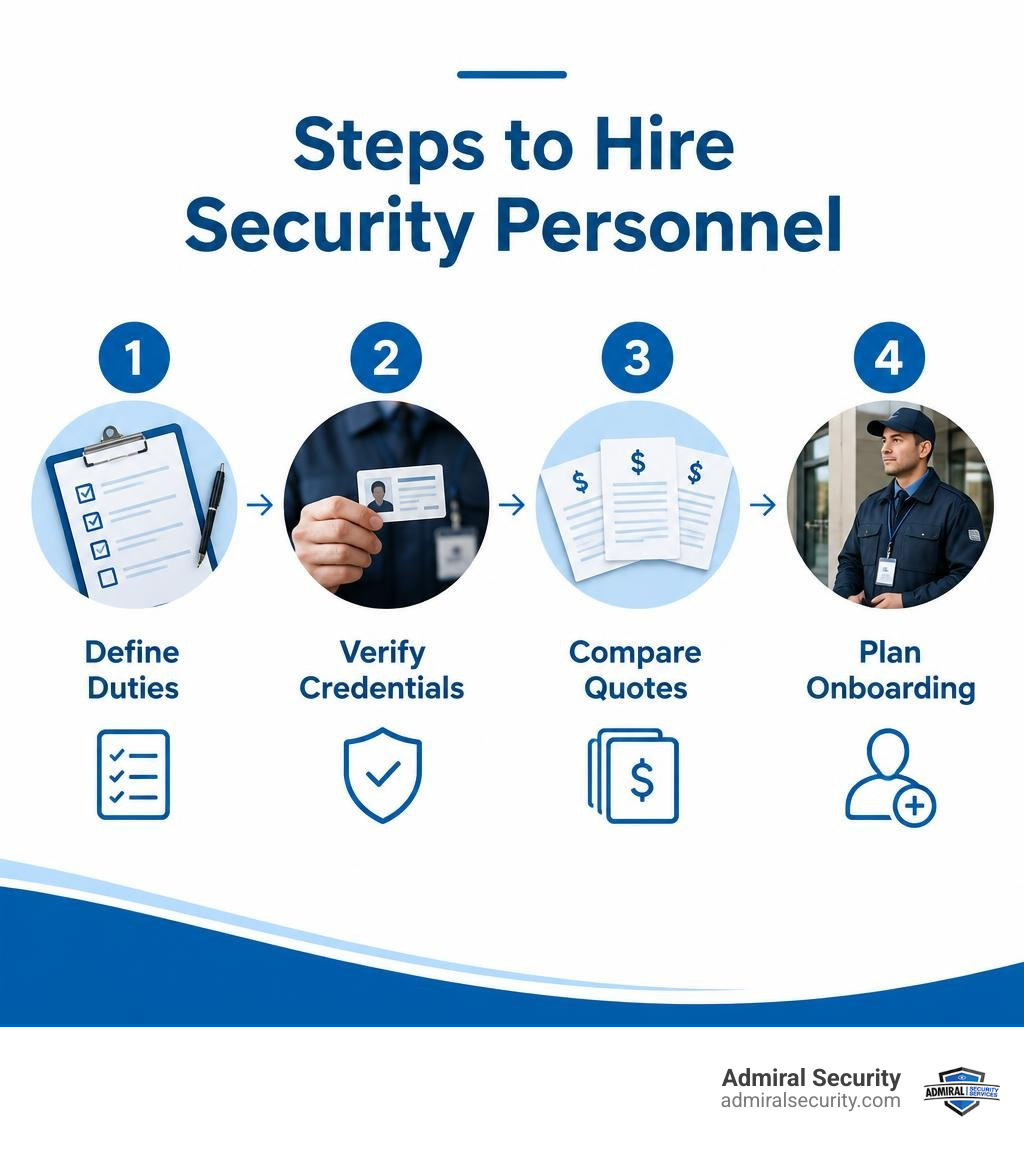
Basic security guard for hire glossary:
Understanding the True Costs of Guard Acquisition
When I evaluate the financial commitment of adding security personnel to a commercial facility, I look far beyond basic hourly wage rates. Many property managers assume that hiring an internal team is straightforward, but the hidden administrative costs often come as a surprise. Across corporate environments in November 2026, the average cost to recruit and onboard any single new employee stands close to $4,700. For security roles, where median annual salaries sit around $37,000, recruiting and credentialing represent a major capital outlay.
Securing quality staff requires extensive advertising, candidate screening, interviewing, and administrative documentation. Human resources teams must draft clear job descriptions, review dozens of applications, coordinate interviews, and maintain compliance files. If a facility decides to use a staffing agency, those third-party recruiting fees typically range between 15% and 30% of the employee’s first-year salary. This means a company might spend anywhere from $5,500 to $11,000 per hire simply to source an individual.
Making sure you are vetting security candidates thoroughly requires substantial investment in time and background screenings. When assessing long-term payroll, reviewing wage statistics and employment data helps establish realistic operational baseline budgets.
| Expense Category | Direct Internal Hiring Model | Contracted Security Solutions |
|---|---|---|
| Initial Sourcing & Recruitment | $4,700 – $11,000 per officer | Included in standard hourly rate |
| Screening & Credentialing | $200+ background check + state fees | Absorbed by service provider |
| Uniforms & Site Equipment | Direct capital expense ($300 – $600) | Fully supplied and maintained |
| Management & Supervision | Internal payroll and HR hours | Dedicated external account supervision |
| Replacement & Turnover Risk | ~33% of annual salary per departure | Immediate coverage guaranteed |
Background Screening and Licensing Standards
I never recommend compromising on compliance and background checks. A comprehensive background check, which covers multi-jurisdiction criminal histories, driving records, reference verifications, and substance testing, regularly exceeds $200 per candidate.
In addition to screening, state regulatory compliance adds administrative steps and mandatory fees. For instance, in areas with strict regulatory boards, initial licensing fees must be paid, recorded, and verified before an individual can legally step foot onto a property. Ensuring every guard holds an active, state-issued security credential avoids costly municipal fines and operational liabilities. Maintaining these records internally requires ongoing administrative oversight to track renewal deadlines and compliance updates.
Direct Hiring Expenses versus Contracted Security Solutions
Managing an in-house security department requires substantial administrative time. Beyond initial sourcing fees, internal teams require dedicated shift supervisors, continuous training coordinators, payroll management, and comprehensive liability coverage. When an internal guard calls in sick or takes vacation, facility managers must scramble to find qualified fill-in coverage or pay overtime rates to maintain facility safety.
When exploring external service agreements through a practical guide to security officer services, you will find that contracting consolidates these fragmented overhead costs into a predictable operational invoice. Partnering with a dedicated agency shifts the burdens of recruitment, turnover mitigation, uniform provisioning, and regulatory compliance away from your internal human resources team.
Key Factors Influencing the Cost of a Security Guard for Hire
Every facility presents unique operational dynamics that dictate security costs. The primary driver is your coverage schedule. A business requiring front-desk coverage during standard business hours operates under a different budget structure than a multi-building commercial park requiring around-the-clock safety coverage. Continuous coverage demands multiple shift rotations, dedicated relief personnel, and robust supervisory oversight to ensure uncompromised reliability across night shifts, weekends, and holidays.
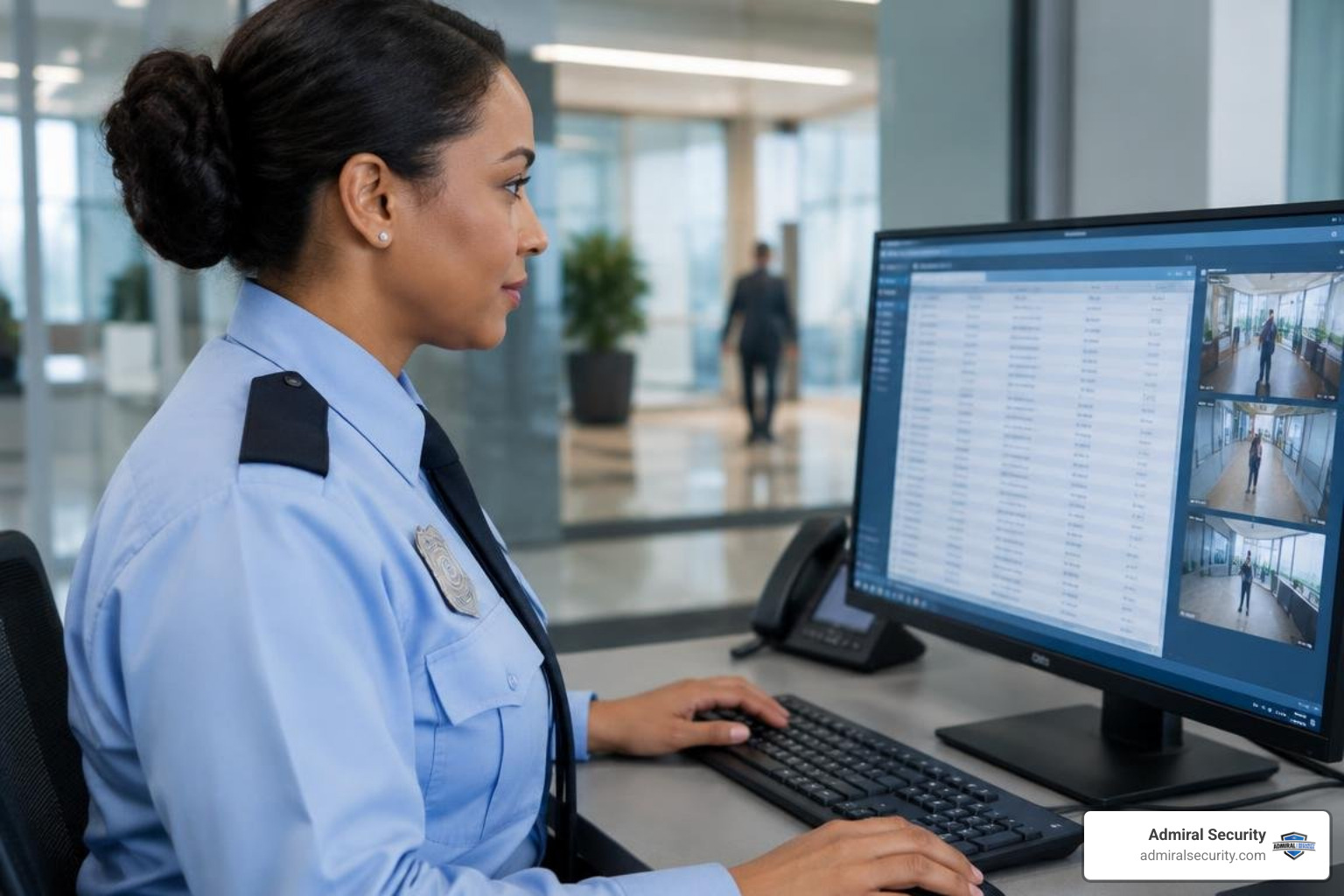
Facility layout and risk profiles also guide billing rates. Properties with high visitor traffic, complex loading docks, or expansive perimeters require advanced access control protocols, visitor badging workflows, and detailed incident logging. As duties expand from standard door observation to comprehensive risk management and building systems monitoring, the required skill level and bill rates adjust accordingly.
Assessing Qualifications Before Selecting a Security Guard for Hire
When I review candidate qualifications, I look for strong situational awareness, clear verbal communication, and dependable customer service abilities. Security officers serve as the visible face of your property. They must project authority while remaining welcoming and helpful to authorized tenants, visitors, and vendors.
Key qualifications to verify include:
- Demonstrated experience in access control management and digital visitor logs
- Clear, professional communication standards during high-stress situations
- Formal instruction in de-escalation techniques and emergency protocols
- Active state registration cards, valid licenses, and verified training certifications
- Punctuality, reliability, and strong attention to perimeter observation detail
Regional Compliance and Geographic Pricing Variations
Geographic location heavily influences security pricing structures. Market rates in major metropolitan business hubs like Boston, Miami, Houston, Dallas, and Tampa reflect local labor standards, municipal licensing rules, and prevailing wages.
Consulting a comprehensive 2026 security officer guide provides valuable clarity on how local wage indexes and compliance mandates shape pricing across regions like Bethesda, Raleigh, Richmond, and Atlanta.
Strategies to Optimize Security Budgets Without Sacrificing Quality
Controlling costs does not mean settling for sub-par personnel. The key lies in streamlining operational workflows, adopting modern management platforms, and choosing partners that deploy their resources efficiently. Proactive planning allows facility managers to maximize every dollar allocated to physical security.

When security agencies leverage digital daily activity logs, automated incident reporting, and integrated site monitoring, officers perform their duties with greater precision. This operational efficiency reduces wasted hours, eliminates paperwork bottlenecks, and improves transparency across your property. Real-time digital checkpoints verify that officers complete scheduled rounds, providing commercial stakeholders with measurable verification of service delivery.
The Advantages of Online Security Guard Training
One of the most effective ways the industry has modernized is through accredited digital training modules. Historically, coordinating in-person training classes created major scheduling delays, travel costs, and instructor fees.
Digital learning platforms allow officers to complete standardized coursework, state compliance modules, and customer service refreshers at their own pace. This approach guarantees that every officer receives uniform instruction on safety protocols, conflict de-escalation, and emergency responses before arriving on site, saving training resources without lowering quality standards.
How Retention Lowers the Cost of a Security Guard for Hire
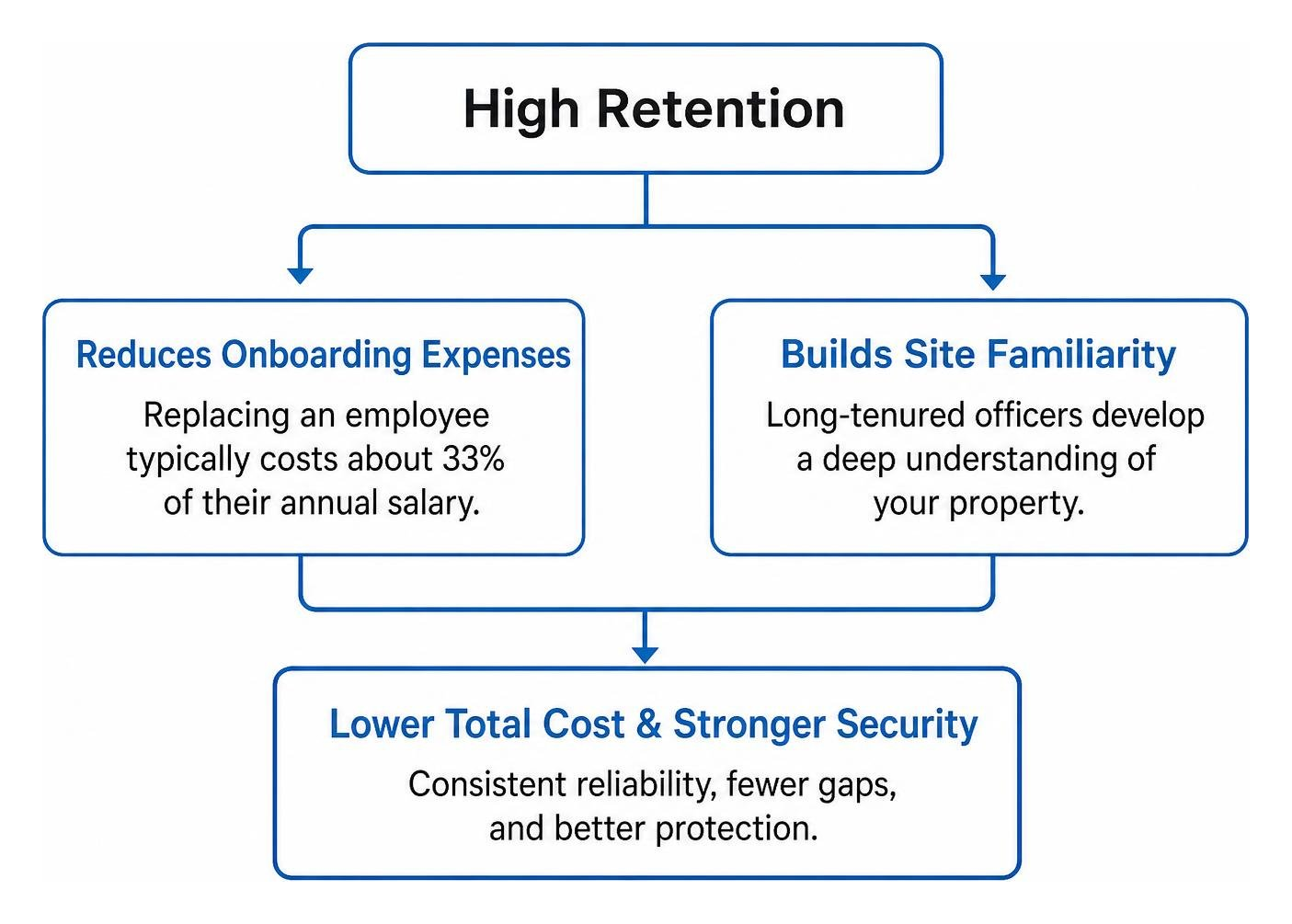
Staff turnover is a major hidden expense in facility operations. Replacing an employee typically costs about 33% of their annual salary, which translates to over $12,000 for a single security position. Frequent turnover creates continuous onboarding cycles, administrative headaches, and gaps in site-specific familiarity.
When security personnel are treated well, paid competitive wages, and supported by attentive management, retention increases significantly. Long-tenured officers develop a deep understanding of your property, recognize regular tenants, detect subtle irregularities quickly, and uphold site standards with consistent reliability.
Frequently Asked Questions About Hiring Security Guards
What are the typical expenses associated with hiring a new security officer?
Direct internal hiring typically costs around $4,700 per officer for basic recruitment. This covers job advertisements, administrative review, background screenings costing upwards of $200, state licensing fees, uniform procurement, and onboarding shadowing. Outsourcing through an established agency rolls these acquisition expenses into a single hourly service rate, removing surprise administrative costs.
How does digital training improve service quality while lowering expenses?
Online training courses deliver standardized, accredited safety and compliance instruction without the high overhead of physical classrooms and dedicated instructors. Officers can review procedures thoroughly at their own pace, ensuring consistent application of access control, emergency protocols, and professional visitor management across all facility shifts.
Why does high guard retention save businesses money over time?
High retention eliminates the recurring 33% replacement cost associated with employee turnover. Furthermore, retaining experienced officers preserves valuable site knowledge, improves tenant relations, reduces training downtime, and maintains steady operational stability across your facility.
Conclusion
Finding the right security solution requires balancing comprehensive risk management, verified officer qualifications, and clear budgetary parameters. By understanding the true expenses behind recruiting, vetting, and training, property leaders can make well-informed decisions that support long-term property value.
At Admiral Security, we deliver dependable uniformed personnel and risk management solutions built on responsiveness, advanced technology integration, and genuine operational support. Our commitment to high retention and rigorous training ensures your property benefits from dedicated, professional personnel every single day.