

The Essential Standards for Background Checked Guards
Background checked guards are security professionals who have passed verified criminal history reviews, fingerprint-based screenings, and state licensing requirements before being deployed to any site.
If you need a quick answer on what standards matter most, here is what to look for:
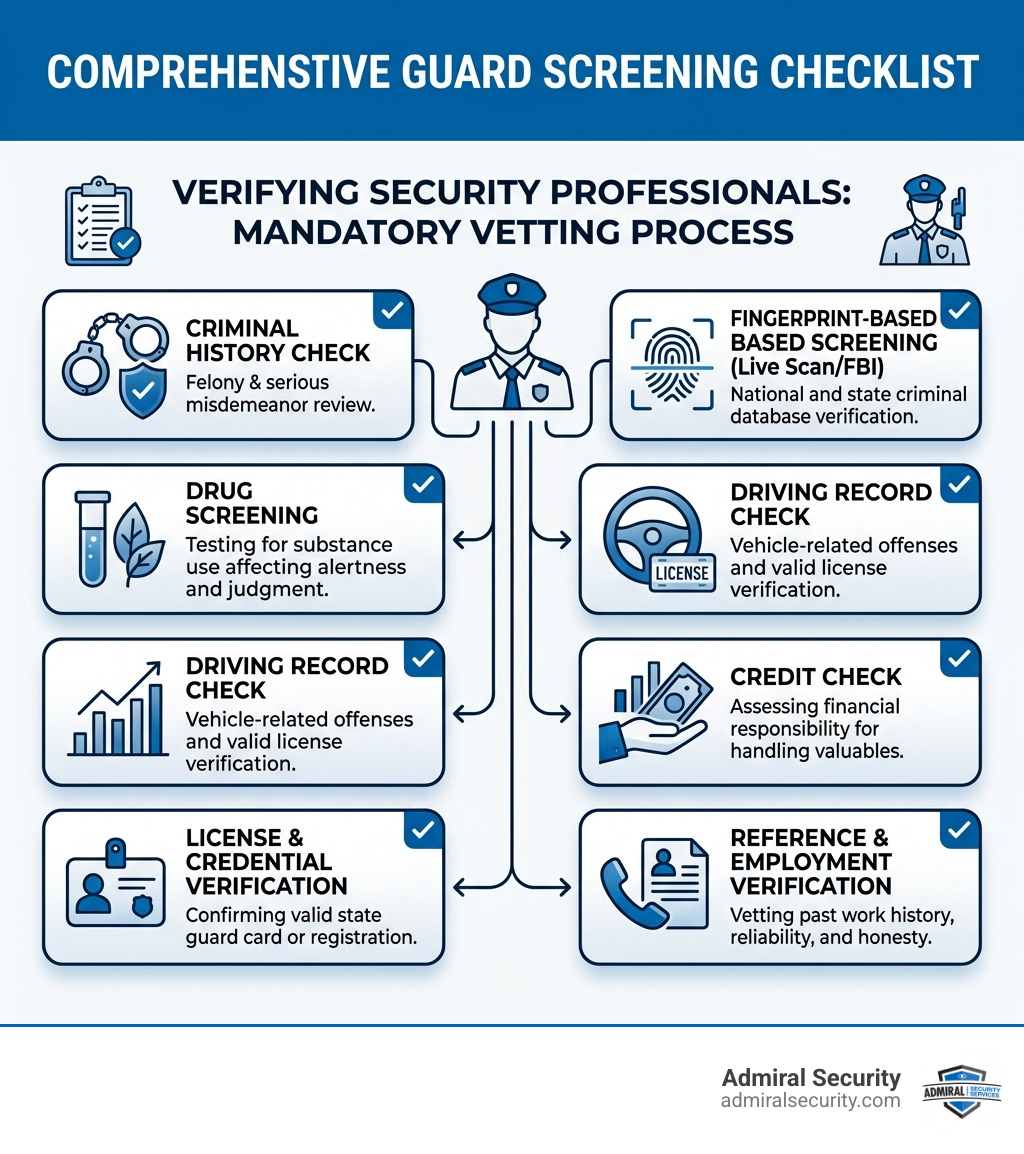
| Screening Type | What It Covers | Required For |
|---|---|---|
| Criminal history check | Felony and serious misdemeanor convictions | All guards, all states |
| Fingerprint-based check (Live Scan/FBI) | National and state criminal databases | Most states, including CA and WA |
| Drug screening | Substance use that affects alertness and judgment | Most professional security companies |
| Driving record check | Vehicle-related offenses and license validity | Guards operating vehicles |
| Credit check | Financial responsibility indicators | Guards handling valuables or cash |
| License and credential verification | Valid state guard card or registration | All states with licensing requirements |
| Reference and employment verification | Past work history, reliability, and honesty | Standard employer-level vetting |
Most states legally require guards to pass a background check before receiving credentials. In California, that means a DOJ and FBI review through Live Scan fingerprinting before a Guard Card is issued. Detailed requirements are available via the Bureau of Security and Investigative Services. In Washington, fingerprint-based checks are mandatory for every applicant, regardless of role.
But state minimums are often just the starting point.
Reputable security companies go further, running checks across national, county, state, and federal criminal databases, verifying employment history going back seven to ten years, and screening for open charges or sex offender registry matches. For certain roles, psychological evaluations and credit checks are also standard.
The stakes are high. A guard with an undisclosed theft conviction, for example, can void an insurance claim if a theft occurs on their watch, and expose your organization to serious legal liability.
This guide walks you through everything you need to know about what a thorough background check covers, how the process works by state, and what separates a truly vetted guard from one who just cleared a basic check.
Why Comprehensive Vetting is Essential for Security Risk Management
When I talk to clients about security risk management, I always emphasize that the quality of your personnel is the foundation of your safety. Hiring background checked guards isn’t just a box to tick for compliance. It is a vital strategy to maintain the integrity of your facility and the safety of everyone inside it.
One of the biggest risks businesses face is the potential for internal threats. If a guard has a history of theft or misconduct that wasn’t caught during the hiring process, the results can be devastating. Beyond the immediate loss of property, there is the issue of insurance viability. Many insurance providers will deny claims if they discover that the person responsible for oversight had a prior criminal record that should have disqualified them from the role.
Furthermore, lawsuit prevention is a major factor. If an incident occurs and it is revealed that an employer failed to properly vet their staff, the company can be held liable for “negligent hiring.” This can lead to massive legal settlements and irreparable damage to your reputation. By ensuring every individual has undergone a deep dive into their history, I help my clients build a wall of defense against these liabilities.
Honesty is another cornerstone of our profession. A background check verifies that the information on a resume matches reality. If an applicant lies about their past, it’s a red flag regarding their future reliability. At Admiral Security, we believe in the Admiral Advantage, which blends authenticity and logic to ensure we only provide the most trustworthy professionals. For more insights on this process, you can read The Essential Guide to Vetting Your Security Personnel.

Beyond Criminal Records: Additional Screenings for Background Checked Guards
A criminal record check is only one piece of the puzzle. To truly understand who is standing watch at your property, I look at several other factors. Comprehensive screenings for background checked guards often include a variety of “heavy-duty” checks that go far beyond what a state-issued license requires.
Drug Testing and Substance Screening
Alertness is non-negotiable in this industry. Federal Executive Order 12564 mandates drug testing for many positions involving public trust, and we follow similar rigorous standards. We want to ensure that every guard is fully present and capable of making split-second decisions without impairment.
Credit Checks
You might wonder why a guard’s credit score matters. For roles that involve handling cash or guarding high-value assets, a credit check can be a predictor of financial responsibility. It helps identify potential risks of theft or fraud. Under the Fair Credit Reporting Act (FCRA), we always disclose when these checks are used and obtain written consent from the applicant.
Driving Records
If a guard is expected to operate a patrol vehicle, their driving history is paramount. We look for patterns of reckless behavior or multiple violations that could lead to safety issues or increased insurance premiums for the client.
Reference and Education Verification
I’ve found that the best predictor of future performance is past behavior. We verify employment history for the last 7 to 10 years and speak with references to assess punctuality, reliability, and how the individual performs under pressure. Using services like S2Verify allows for rapid, accurate results, often within 12 to 24 hours, ensuring we don’t rush the process but still move efficiently.
To learn more about why these extra steps are so important, check out our post on Hiring Vetted Security Officers.
Navigating State Licensing and Compliance Requirements
The rules for becoming a licensed guard vary significantly depending on where you are. Since I work across various regions like Maryland, Virginia, Florida, and Texas, I have to stay on top of these shifting regulations to keep our clients compliant.
California (BSIS)
California has some of the most stringent requirements in the country. The Bureau of Security and Investigative Services (BSIS) oversees over 180,000 licensed guards. Every applicant must undergo a DOJ and FBI criminal history review via Live Scan. Processing times can be lengthy, often 30 to 45 days for unarmed roles. Additionally, guards must complete 40 hours of training, including a “Power to Arrest” course, before they can even start working.
Washington (SAW and Identogo)
In Washington, the process is equally rigorous. Applicants must use the SecureAccess Washington (SAW) portal and schedule fingerprinting through Identogo. We ensure that every guard we deploy in these regions has a verified application number and has cleared their state-mandated checks.
Penalties for Non-Compliance
Failing to hire vetted, licensed guards isn’t just a safety risk; it’s a financial one. In Illinois, for example, companies can be fined up to $10,000 for knowingly hiring an unlicensed guard. California companies face fines of up to $5,000 per violation. I make it my mission to ensure our clients never face these penalties by maintaining strict adherence to all regulatory standards.
Disqualification Criteria and the Appeals Process
Not every mistake in a person’s past should bar them from employment forever, but there are certain “hard lines” we cannot cross. Understanding what disqualifies a candidate is essential for transparency.
Typical Disqualifying Offenses
Most states and professional agencies will automatically disqualify candidates for:
- Murder or manslaughter
- Sexual offenses requiring registration
- First-degree kidnapping
- Recent felonies (usually within the last 7 to 10 years)
- Serious misdemeanors involving violence, fraud, or domestic abuse
The Seven-Year Rule and Rehabilitation
In many states, such as California, offenses older than seven years may be considered on a case-by-case basis. This is where the appeals process comes in. If an applicant has been denied a license, they often have the right to submit an appeal within 30 days.
I’ve seen cases where candidates provide “evidence of rehabilitation.” This includes character references, proof of steady employment, and court documents showing they have turned their lives around. While we maintain the highest standards for our background checked guards, we also recognize the value of growth and logic in our hiring decisions. However, for high-security roles, we may look back at a candidate’s history for 15 years or even their entire lifetime.
Frequently Asked Questions about Background Checked Guards
How long does a security guard background check typically take?
Processing timelines depend heavily on the state and the depth of the check. For a basic unarmed position, you can expect 30 to 45 days. If the candidate has a complex history or is applying for a role that requires more intensive screening, it can take 60 to 90 days. We always recommend starting the application process early to avoid delays in deployment.
What specific criminal offenses typically disqualify candidates?
As mentioned, felonies are the primary disqualifier. Specifically, crimes involving robbery, assault, fraud, and theft-related offenses are major red flags. Domestic violence convictions also carry heavy weight, especially in roles where conflict resolution is a daily task.
How often should security guards undergo re-verification?
Vetting isn’t a “one and done” event. I recommend annual background re-checks for high-risk environments. Most states require license renewal every two years (biennial), which involves a fresh look at the guard’s criminal standing. At Admiral Security, we believe in continuous monitoring to ensure our team remains as reliable as the day they were hired.
Conclusion
Hiring background checked guards is about more than just checking a database. It is about building a culture of trust and ensuring that the people responsible for your safety are worthy of that responsibility. At Admiral Security, we bring the “Admiral Advantage” to every site we serve. By combining empathy for our employees with the cold logic of rigorous vetting, we provide a level of service that is unmatched in the industry.
Whether you are in Bethesda, Richmond, or Houston, my team is ready to provide you with the peace of mind that comes from knowing your personnel are truly vetted. Don’t leave your safety to chance.