

How Access Control Security Systems Help Guards Respond
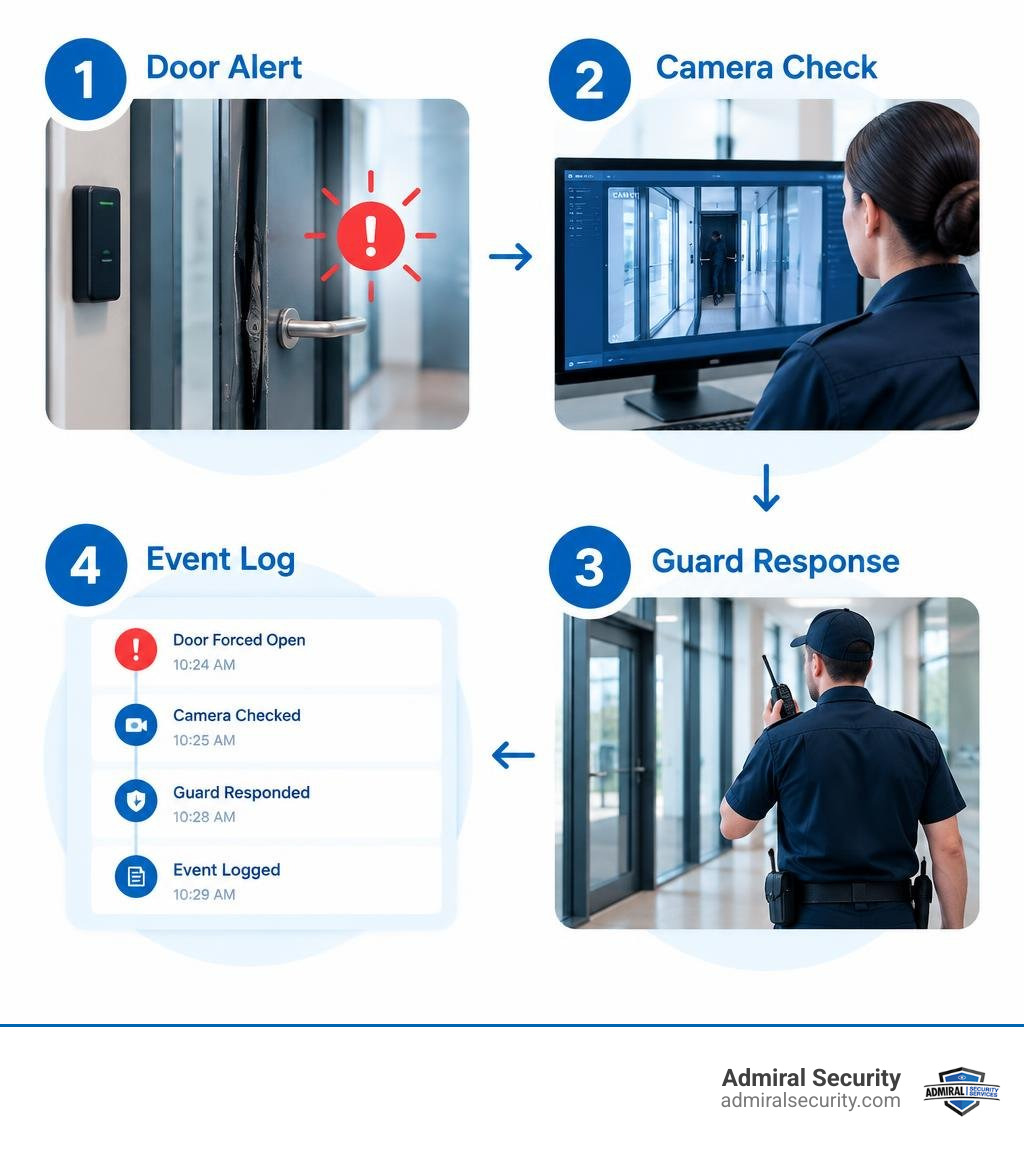
To sync access control security systems with surveillance and on-site guards, connect door alerts to the right camera feed and give officers a clear response plan. When a door is forced open or a credential is denied, the team can see where it happened, check the video, and respond based on the risk.
The useful part is not just faster alerts. It is giving trained officers the context they need to act, while keeping a record of the door event and response.
Quick access control security systems definitions:
Physical security operates across three vital phases: detection, delay, and response. Access control provides the critical delay mechanism by securing perimeter doors, turnstiles, and interior gates. Video surveillance handles detection and visual assessment. Trained security personnel deliver the targeted response. When these elements operate in separate silos, critical seconds are lost. By linking these domains, I help organizations create an active, responsive security environment.
Core Architecture of Access Control Security Systems
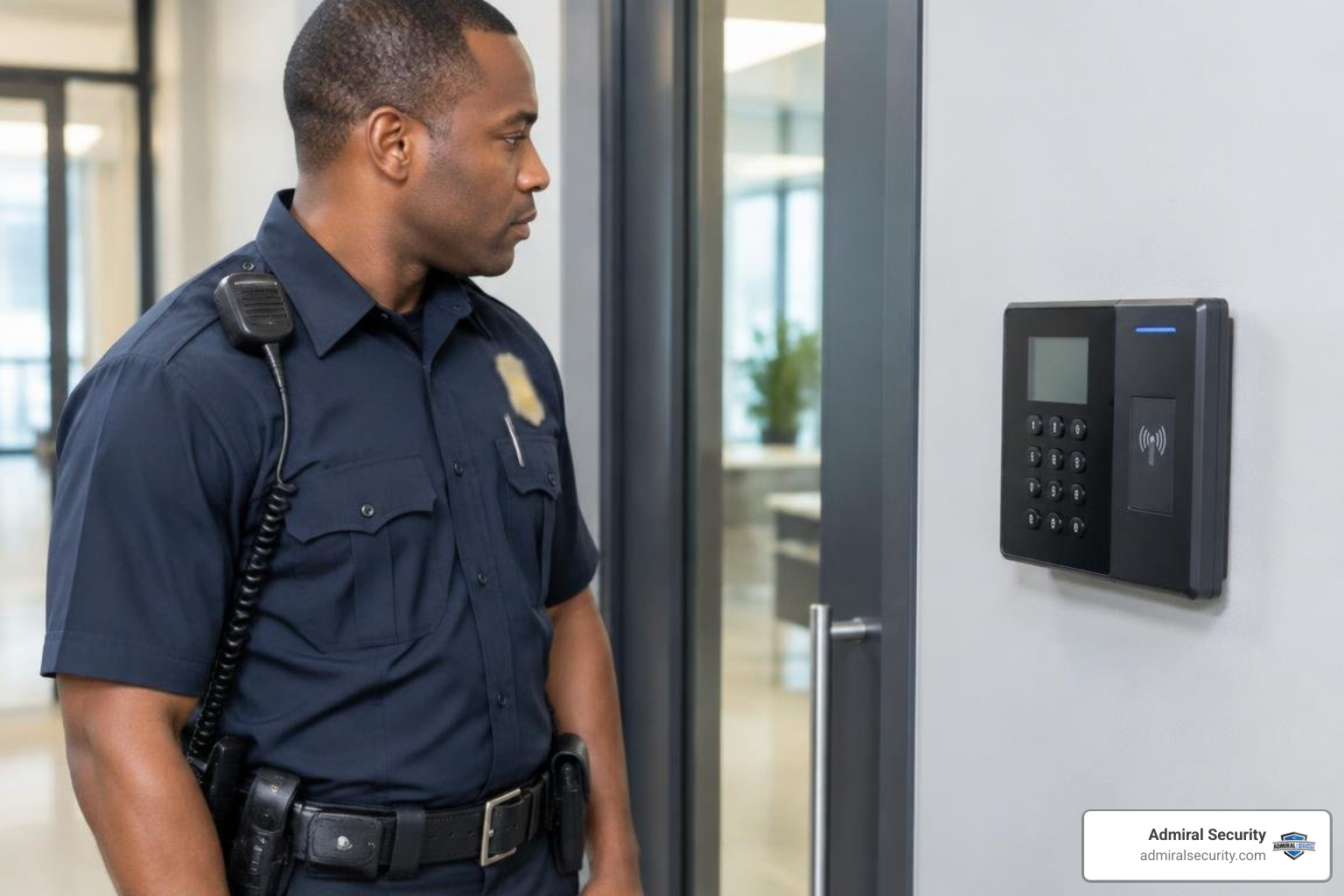
To build a reliable setup, we must understand the core architecture of physical access control. While logical access control governs entry to computer networks, databases, and digital files, physical access control manages entry to buildings, sensitive rooms, and physical assets. To explore these fundamentals further, review this overview of physical security systems.
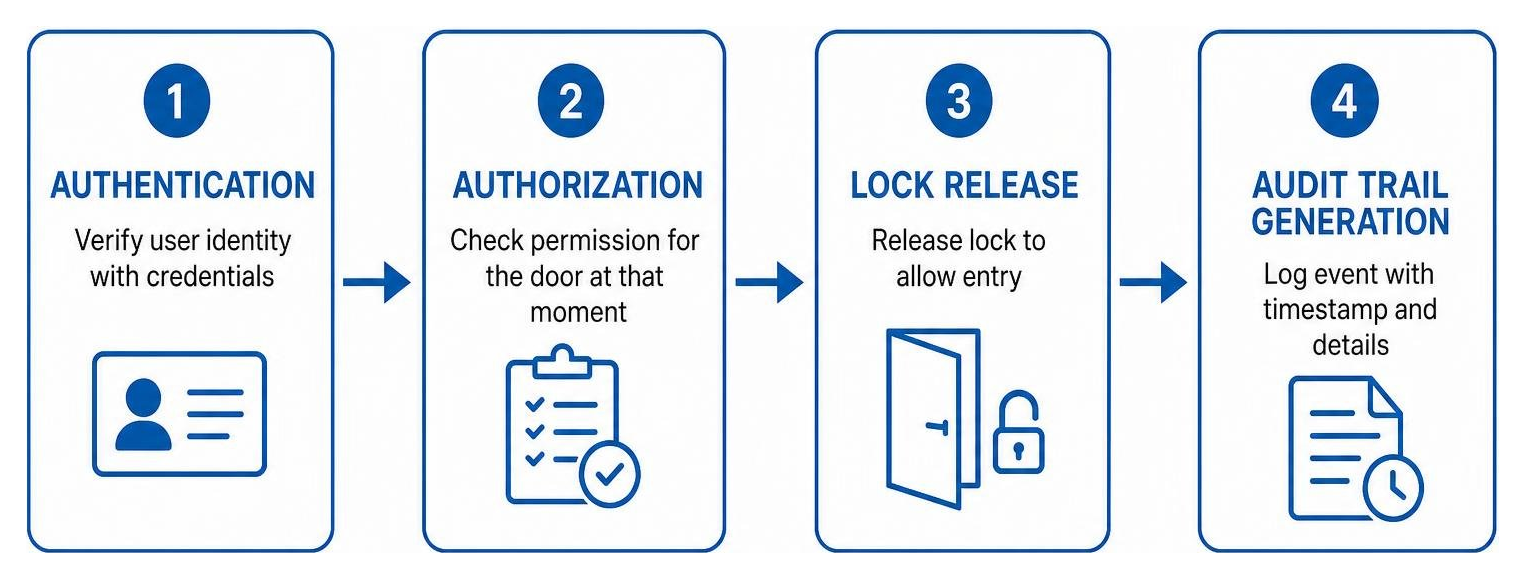
Modern access platforms run on five core functional components:
- Authentication: Verifying the user’s identity through credentials.
- Authorization: Determining whether the authenticated individual has permission to enter a specific door at that moment.
- Access: The physical release of electrified locking hardware, such as magnetic locks or electrified mortise strikes.
- Management: The central software platform where administrators configure door schedules, permissions, and credential issuance.
- Audit: The detailed time-stamped logging of every successful entry, denied attempt, door held open, or forced entry alarm.
Modern facilities employ various credential types ranging from traditional smart cards and encrypted fobs to mobile credentials utilizing Bluetooth Low Energy (BLE) or Near Field Communication (NFC). High-security zones, such as data halls or research labs, often require biometric hardware. For more on biometric entry hardware, see our guide on fingerprint scanner access control.
At the hardware communication layer, older systems relied on unencrypted legacy protocols such as Wiegand. Today, secure deployments require Open Supervised Device Protocol (OSDP) with Secure Channel encryption. OSDP establishes two-way communication between the reader and controller, preventing credential skimming, intercept attacks, and wiring tampering at the perimeter.
Access Control Models: MAC, DAC, RBAC, and ABAC
When designing entry policies, organizations generally choose from several foundational models:
- Mandatory Access Control (MAC): The most rigid security model, commonly used in government facilities and defense installations. Access permissions are strictly managed by a central authority based on assigned clearance levels. End users cannot modify permissions.
- Discretionary Access Control (DAC): The resource owner determines who is granted access. While highly flexible, DAC can lead to administrative oversight and privilege creep in large commercial properties.
- Role-Based Access Control (RBAC): The industry standard for commercial enterprises. Permissions are assigned directly to job roles (such as “Warehouse Staff” or “Executive Personnel”) rather than individual names. When an employee changes roles, updating their group membership automatically reconfigures their door permissions.
- Attribute-Based Access Control (ABAC): A dynamic, context-aware model. ABAC evaluates multiple attributes before granting entry, including user role, time of day, entry point location, and current threat levels.
- Rule-Based Access Control: Policies operate on predefined conditions, such as automatically locking public lobbies at 6:00 PM or requiring two-person authentication during off-hours.
Applying these models enforces the principle of least privilege, ensuring personnel only access areas strictly required for their operational responsibilities.
Cloud-Based vs. On-Premises Deployment Architectures
Organizations must choose between on-premises installations and cloud-managed Access Control as a Service (ACaaS). As highlighted in recent access control system market trends, cloud deployments are growing rapidly due to their centralized visibility across multi-site portfolios.
| Feature / Capability | Cloud-Based Access Control (ACaaS) | On-Premises Access Control |
|---|---|---|
| Server Infrastructure | Zero on-site servers; managed in redundant cloud | Dedicated local servers required on-site |
| Maintenance Overhead | Automatic software, firmware, and patch updates | Manual IT maintenance, patching, and backups |
| Remote Management | Real-time unlocking and provisioning via web/mobile | Local client software or VPN connection required |
| Multi-Site Scalability | Add sites and doors instantly across global locations | Requires site-to-site networking and complex licensing |
| Offline Reliability | Controllers store local databases for full offline function | Controllers maintain local database and schedule buffers |
| Upfront Capital Cost | Lower initial hardware outlay with operational subscription | High upfront investment in server hardware and licenses |
| Third-Party Integrations | Open REST APIs for identity providers and visitor tools | Integration depends on custom SDKs and local middleware |
Modern cloud platforms use edge-capable network door controllers. These controllers cache access permissions locally, ensuring doors continue to lock, unlock, and authenticate badges normally even if the facility experiences an internet disruption.
Integrating Video Surveillance and Sensor Streams with Access Management
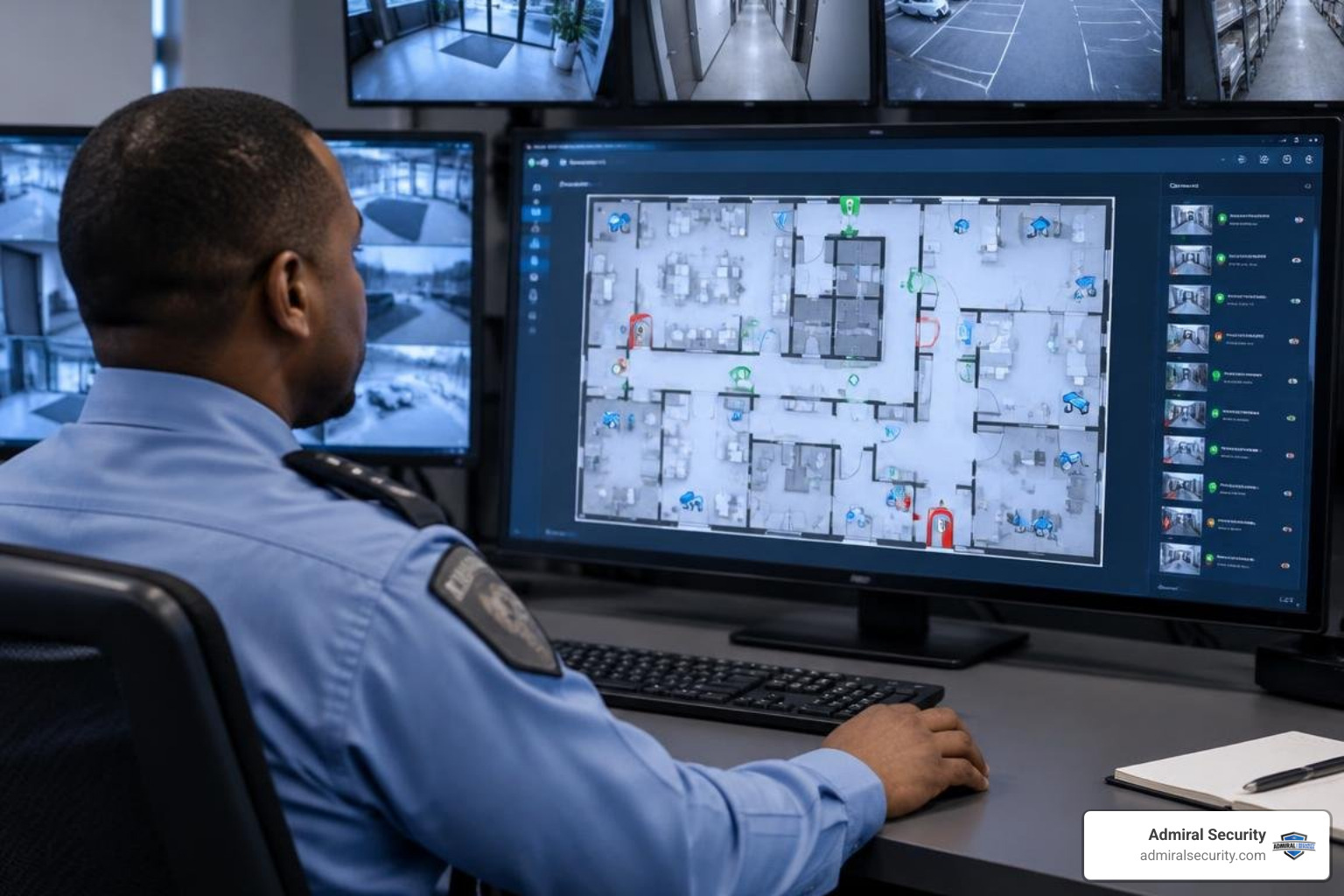
Connecting door hardware with video surveillance bridges the gap between digital logs and situational context. When an access event occurs, a unified platform provides visual verification by pairing the door sensor with the corresponding camera view. Discover more strategic camera setups in our complete guide to video monitoring options.
Industry-standard protocols like Open Network Video Interface Forum (ONVIF) allow cameras, door controllers, and Network Video Recorders (NVRs) to communicate seamlessly. When a door forced open (DFO) alarm is tripped, the integrated platform instantly triggers automated Pan-Tilt-Zoom (PTZ) presets to focus on that specific threshold. If an employee uses an invalid credential, the system can display the live camera stream alongside the user’s stored badge photo on the guard console, making credential sharing obvious.
Evaluating Top Access Control Security Systems for Commercial Facilities
Commercial properties need scalable, open-architecture platforms. You can review foundational setup steps in A Quick Start Guide to Access Control.
Modern platforms fall into three primary categories:
- Cloud-Native and Hybrid Platforms: Systems designed around native cloud management and mobile credentials provide rapid deployment, automated updates, and seamless multi-site administration. They allow security managers to issue mobile passes instantly to smartphones, eliminating the cost and administration of physical plastic badges.
- Enterprise Modular Controllers: High-capacity hardware controllers excel in sprawling enterprise environments, hospitals, and critical infrastructure. These units can manage dozens of doors per enclosure and process thousands of transactions per second across complex networks.
- Integrated Wireless Lock Ecosystems: Wireless electronic locks extend access control deep into commercial buildings, covering interior office doors, conference rooms, and server cabinets without the expense of running hardwired conduit to every frame.
Leading systems also integrate directly with visitor management kiosks, automating temporary QR-code guest passes, as well as destination-dispatch elevator banks to guide visitors only to authorized floors.
Bridging Alarm Sensors and Central Monitoring Platforms
A fully integrated facility links access management with certified intrusion detection systems. Learn more about evaluating unified architectures in our guide on comparing security monitoring solutions.
Underwriters Laboratories standards dictate the engineering and operation of these systems:
- UL 681: Governs the installation and classification of commercial burglar alarm systems, defining proper sensor placement, wiring shielding, and tamper detection.
- UL 2050 and UL 827: Regulate the operation, signal processing, and response times of central monitoring stations.
Central monitoring facilities use verified alarm procedures to reduce false alarms. When an exterior motion sensor or glass-break detector triggers, the central station operator cross-references the live camera feed and access logs. Once human activity is visually confirmed, operators coordinate immediate response protocols. For additional public-sector deployment examples, check out these smart access management examples.
Operationalizing Technology for On-Site Guard Teams
Advanced access technology works best when put directly into the hands of trained, on-site personnel. Handing patrol officers mobile tablets connected to the central security dashboard transforms passive foot patrols into active, responsive operations. To see this in action, explore our work on mobile patrol and CCTV coordination.
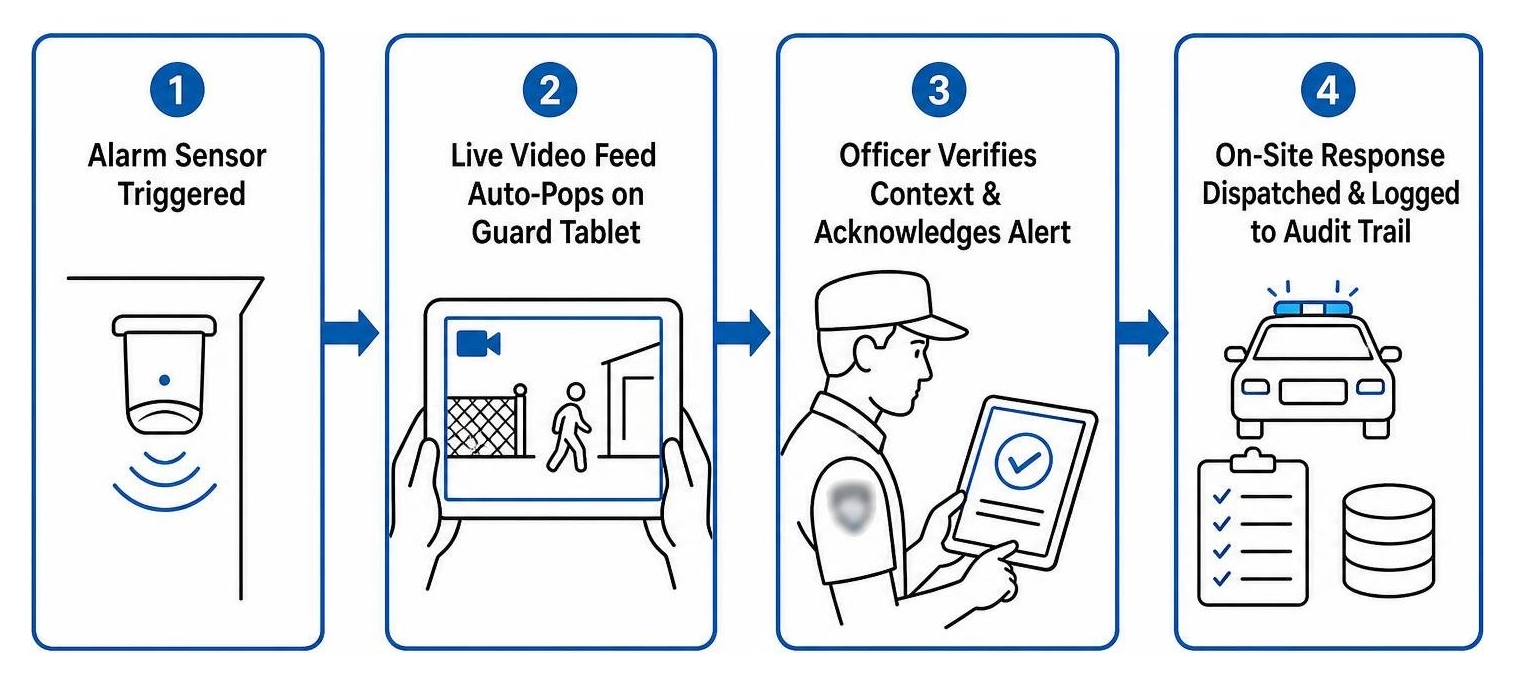
When a perimeter intrusion alarm triggers, the system pushes the location and live camera stream directly to the nearest officer’s mobile device. This allows guards to evaluate the scene before arriving. In high-security vestibules and mantraps (interlocking two-door security portals), access software prevents both doors from unlocking simultaneously, while officers oversee entry verification.
Aligning Access Control Security Systems with On-Site Guard Workflows
Integrating access management into daily security routines streamlines procedures and strengthens building security:
- Instant Credential Revocation: If an employee is terminated or a badge is lost, administrators can revoke access rights in seconds across all facilities, removing the risk of unauthorized entry.
- Break-Glass Emergency Procedures: In a critical emergency, officers and authorized administrators can trigger a localized or site-wide lockdown, or initiate a break-glass override to unlock life-safety egress routes instantly.
- Visitor Badging Kiosks: Lobby security personnel use integrated visitor management tools to scan government IDs, capture guest photos, check watchlists, and issue time-limited digital badges.
- Anti-Tailgating Detection: Overhead analytics and optical turnstiles alert guards when an unauthorized person follows closely behind an authorized employee through a secure doorway.
- Guard Tour Verification: Officers check in at designated access readers or NFC checkpoints along their patrol route, automatically logging their progress and confirming thorough coverage.
Compliance and Audit Readiness Across Regulated Sectors
Organizations across regulated industries must maintain strict physical access boundaries to meet legal and operational standards:
- HIPAA: Mandates physical safeguards to prevent unauthorized entry to areas housing electronic health records (ePHI), such as server closets, medical records rooms, and pharmacy storage.
- PCI DSS: Requires strict physical perimeter controls, multi-factor entry to server rooms, and continuous monitoring of data centers where payment card data is processed.
- SOC 2 and ISO 27001: Demand comprehensive audit trails, regular access permission reviews, and tamper-resistant logging of all physical access to technology infrastructure.
By utilizing unified systems, security risk management teams can generate automated audit reports in minutes, demonstrating continuous compliance.
Frequently Asked Questions About Access Control Integration
How do access control security systems improve guard response times?
When door alerts connect directly with camera feeds, guards do not have to guess what caused an alarm. The security management console automatically displays the relevant camera view the moment an unauthorized entry attempt or door held open alarm occurs. This immediate context allows on-site officers to assess the risk instantly and respond directly to the exact location.
What is the difference between physical and logical access control?
Physical access control manages and restricts movement through physical entry points, such as gates, perimeter doors, elevators, and server rooms, using hardware like badge readers and turnstiles. Logical access control governs access to digital networks, databases, software applications, and corporate files through passwords, multi-factor authentication, and identity providers like Active Directory or Okta. Integrating both creates a unified identity ecosystem where revoking an employee’s account automatically deactivates their physical building keycard.
Can existing analog surveillance and door hardware be integrated with modern cloud platforms?
Yes. Organizations do not need to replace their entire infrastructure all at once. Modern access controllers and IP bridge appliances can interface with legacy door strikes, magnetic locks, and request-to-exit sensors. Similarly, video encoders can convert existing analog CCTV camera signals into digital network streams, allowing businesses to adopt modern cloud management through a phased, budget-conscious migration.
Conclusion: Building an Integrated Security Posture
Securing modern commercial facilities requires seamless collaboration between advanced technology and professional personnel. When access control hardware, video surveillance streams, and alarm sensors work together, they provide the visibility necessary to identify operational risks early.
At Admiral Security, I help commercial properties combine state-of-the-art access management with responsive security officers. Serving major metropolitan markets across the United States, including Bethesda, Baltimore, Richmond, Virginia Beach, Raleigh, Miami, Orlando, Tampa, Houston, Dallas, Austin, and Boston, our team delivers the Admiral Advantage through authentic, logical, and responsive service.
By connecting smart electronic access hardware with trained personnel, your organization secures property value, maintains regulatory compliance, and ensures an efficient environment for employees and visitors. Explore our integrated technology and monitoring solutions to learn how we can assist your facility.