

Core Categories of Safety and Security Training
When I evaluate a comprehensive safety and security training curriculum, I look far beyond standard compliance checklists. True workplace readiness relies on layers of practical skills that help personnel read their environments, diffuse tension, and react decisively when an operational threat emerges.
Effective workplace safety programs focus on three primary skill categories: proactive detection, interpersonal defusal, and structured emergency response. Programs like Security Prevention Essentials Training demonstrate that true security success often looks like silence. When teams spot vulnerabilities early, incidents are resolved quietly before they can escalate into disruptive events.
Situational Awareness and Early Threat Detection
Most safety failures do not happen because an organization lacks access control technology or written guidelines. They happen because someone missed subtle behavioral changes or environmental cues. Situational awareness is the practice of establishing a baseline for normal activity in a facility so that deviations stand out immediately.
I teach teams to focus on active observation rather than passive watching. Grounding training in behavioral research, such as the Department of Defense funded “Just Doesn’t Look Right” project, helps employees establish systematic baselines. Staff members learn to identify:
- Environmental baselines: Recognizing standard foot traffic patterns, typical delivery routines, and authorized access points.
- Behavioral deviations: Noticing individuals who display unnatural pacing, avoid eye contact, or linger in restricted areas.
- Structural vulnerabilities: Identifying propped exterior doors, non-functioning lighting, or obscured security sightlines.
Understanding these cues allows personnel to report concerns early. To explore how front-line personnel apply these observation techniques on site, read our guide on Why Your Business Needs De-Escalation Trained Guards Today.
De-Escalation and Conflict Management
When dynamic situations arise, communication is usually the most effective tool available. De-escalation training equips guards, staff, and customer-facing teams with verbal tactics designed to lower emotional intensity and manage stress.
Instead of matching an agitated individual’s volume or aggression, trained employees use specific verbal strategies:
- Rapport building: Using a calm tone, active listening, and empathetic non-verbal cues to build temporary trust.
- Verbal influence: Offering clear, non-confrontational choices that restore a sense of control to the individual.
- Tactical positioning: Maintaining safe physical distance while keeping open exit routes for all parties.
Defusing conflict at the lowest possible level lowers risk for everyone involved, maintaining a stable environment without unnecessary physical engagement.
Active Threat and Emergency Field Protocols
When dangerous incidents occur, spontaneous action can lead to confusion. Structured emergency protocols ensure every employee understands their role during lockdowns, evacuations, and severe weather emergencies.
Active threat instruction focuses on rapid decision-making under high-stress conditions. Drills and walkthroughs teach personnel how to identify secure shelter locations, execute facility lockdown protocols, and communicate effectively with emergency responders. Repeated practice turns panic into clear action, ensuring critical evacuation steps become second nature.
Industry-Specific Compliance and Mandates
Safety protocols are not one-size-fits-all. Regulatory agencies and industry standards dictate distinct baseline requirements across different sectors.
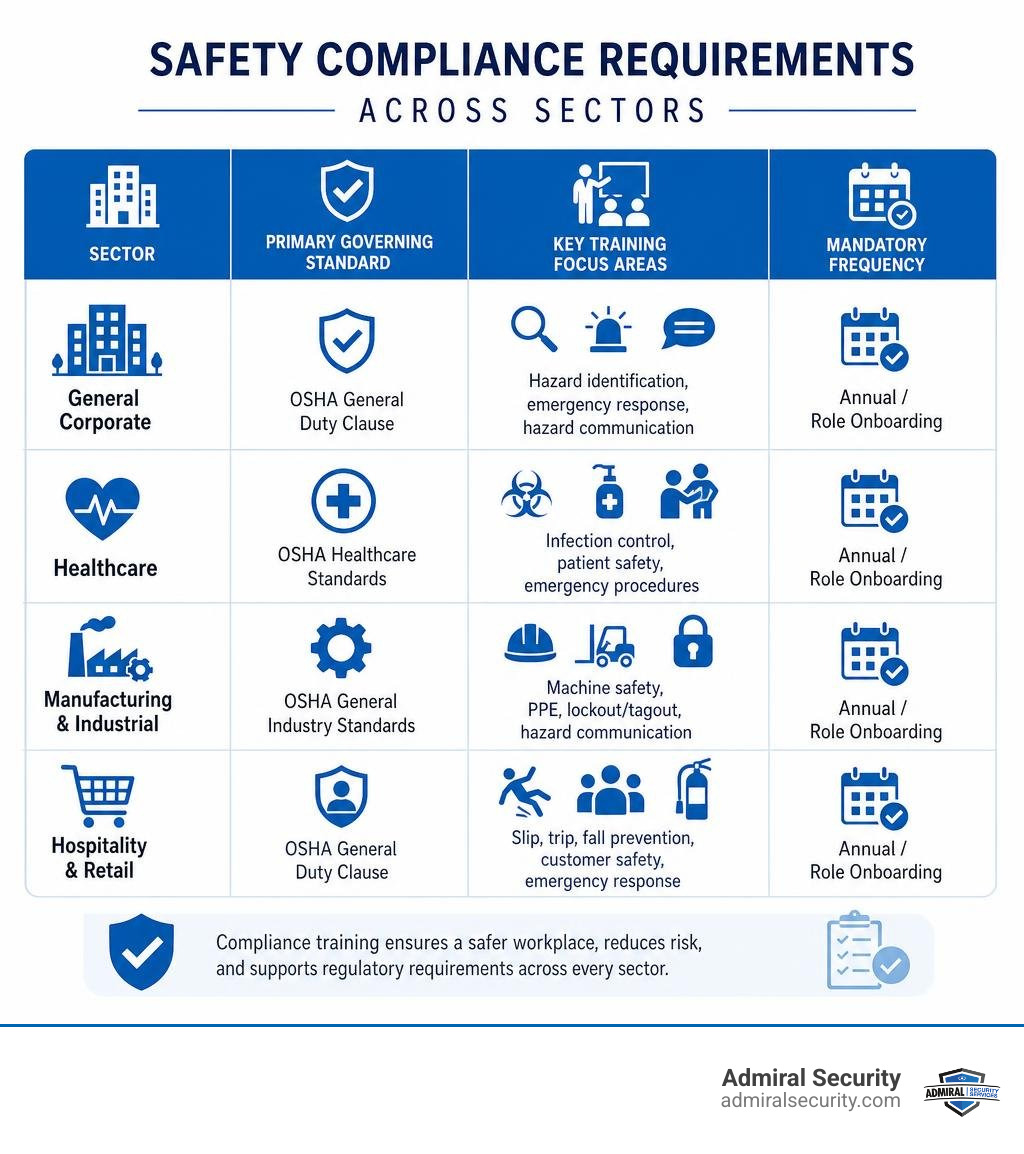
Federal OSHA guidelines mandate that employers provide hazard awareness training to workers who encounter workplace risks before they begin potentially hazardous duties. While OSHA 10-Hour and 30-Hour cards are standard general industry frameworks, specific operating environments carry unique statutory requirements.
| Sector | Primary Governing Standard | Key Training Focus Areas | Mandatory Frequency |
|---|---|---|---|
| General Corporate | OSHA General Duty Clause | Hazard identification, emergency response, hazard communication | Annual / Role Onboarding |
| Education | State Educational Codes | Situational awareness, emergency drills, behavioral health | Annual (2–3 hours minimum) |
| Maritime | ISPS Code / STCW | Vessel access control, shipboard security awareness, designated security duties | Initial certification & periodic renewals |
| Field / Humanitarian | UN / Duty of Care standards | Vehicle safety, field health, critical incident management, risk assessment | Pre-deployment & tiered updates |
School Safety and Educational Standards
Educational institutions face rigorous regulatory mandates to maintain secure learning spaces. State frameworks, such as Pennsylvania’s Act 55, require annual employee training covering situational awareness, behavioral health, trauma-informed approaches, and suicide prevention.
These regulations often dictate strict structural formats. For example, employee modules covering general awareness topics must meet minimum hour requirements, while emergency drill instruction must be delivered in person rather than through online modules. Additionally, appointed School Safety and Security Coordinators are frequently required to complete comprehensive multi-hour leadership curricula within one year of taking office.
Maritime and Field Operations
Maritime safety requires strict adherence to international maritime law. Courses aligning with the International Ship and Port Facility Security (ISPS) Code and the STCW Convention set rigorous standards for maritime personnel.
Magsaysay Training Center outlines detailed Course Details for Ship Security Awareness Training and Seafarers with Designated Security Duties (SDSD), ensuring crew members pass health evaluations and meet international standards.
For personnel deployed in civil defense or international missions, programs like the European Union’s Safety and Security Course (SEC) provide core threat recognition skills. The SEC program requires a minimum score of 80% on a 27-question evaluation test to certify personnel for international deployment. Similarly, non-profit and field workers rely on resources like Online Training, The IFRC Guide to a Safer Mission, which has trained over 150,000 individuals with a 4.8 out of 5 satisfaction rating.
Specialized Safety and Security Training for High-Risk Environments
Operating in high-threat locations requires specialized field instruction. The United Nations System Staff College delivers the Trainer Development Certification Course (TDC) and Safe and Secure Approaches in Field Environments (SSAFE).
This intensive 8-day program costs $3,600 USD per participant and combines adult learning methodologies with practical field vignettes, such as vehicle security and crisis scenarios. To receive full certification, prospective trainers must successfully deliver an actual field training course within 12 months of completing their evaluation.
Designing an Effective Program Strategy

Creating a sustainable security program requires moving from reactive training sessions to a structured, continuous learning model. For a broader overview of structuring professional security operations, explore The Definitive Guide to Security Training Services.
An effective training strategy follows a multi-step continuous cycle:
- Risk Assessment: Evaluate facility layout, crime data, access points, and employee risk exposure.
- Curriculum Design: Match industry compliance standards with role-specific behavioral modules.
- Blended Delivery: Combine flexible digital learning for theoretical concepts with hands-on practice for physical responses.
- Testing and Drills: Validate skills through practical scenarios and knowledge testing.
- Review and Refine: Adjust instruction based on drill metrics and operational changes.
Role-Based Customization and Risk Tiers
Not every employee faces the same operational risks. Segmenting training into customized risk tiers ensures individuals receive detailed, relevant instruction without overwhelming office staff with unnecessary protocols.
- Tier 1: General Staff and Office Personnel: Focuses on baseline situational awareness, facility access rules, visitor control, basic hazard communication, and evacuation routes.
- Tier 2: Public-Facing and Frontline Workers: Adds de-escalation tactics, customer conflict management, field safety, and early behavioral threat recognition.
- Tier 3: Security Officers and On-Site Supervisors: Focuses on access control management, emergency protocol execution, physical perimeter safety, incident command, and advanced de-escalation.
- Tier 4: Leadership and Security Coordinators: Focuses on critical incident management, security risk management, legal compliance, media coordination, and facility hardening strategy.
Online vs. In-Person Safety and Security Training Options
Choosing between digital platforms and in-person instruction depends on the nature of the skills being taught. Digital learning offers flexible pacing, lower costs, and consistent tracking for regulatory topics like hazard awareness or compliance refreshers.
However, physical emergency drills, practical de-escalation practice, and active threat responses require hands-on experience. State regulatory bodies often dictate delivery formats for official guard licensing and security certifications. For example, Virginia’s Department of Criminal Justice Services outlines official alternatives through A Security Training Academy, Inc., while regional academies like the 1st Virginia Public Safety Training Academy provide structured, in-person tactical training. You can read more about state licensing rules in our detailed breakdown on Licensed Security Guards and How to Get Certified in Your State.
Measuring Effectiveness and Program Improvement
Training is only valuable if it drives reliable real-world performance. I measure program success through clear performance indicators rather than simple attendance records:
- Knowledge Assessments: Establishing pass thresholds, such as an 80% score requirement on knowledge exams, ensures material comprehension.
- Drill Execution Metrics: Tracking lockdown speeds, evacuation times, and communication clarity during simulated emergencies.
- Incident Escalation Rates: Monitoring whether situational awareness and de-escalation instruction reduce physical incidents over time.
- Continuous Feedback: Updating course materials based on security risk management evaluations and internal security audits.
Frequently Asked Questions About Workplace Safety
What are the annual training requirements for school safety officers?
Mandatory training hours for educational safety personnel vary by state legislation. In states like Pennsylvania, general school employees must complete a minimum of three hours of safety instruction annually, covering situational awareness, behavioral health, and emergency drills. Appointed School Safety and Security Coordinators face expanded standards, often requiring a dedicated 7-hour leadership curriculum within one year of their appointment date.
How often should employees refresh their safety and security skills?
Core safety competencies should be refreshed at least once a year to ensure rules and emergency steps stay clear. High-turnover teams or frontline workers operating in high-risk environments benefit from quarterly refresher sessions. Additionally, physical emergency drills, such as facility evacuations and lockdown walk-throughs, should be practiced twice a year to reinforce quick, automatic responses during real threats.
Are online safety certifications recognized by regulatory bodies?
Many state authorities and regulatory agencies accept online instruction for theoretical modules, security awareness, and continuing education credits. For example, specific courses provide continuing education units such as ASIS CPEs or SHRM PDCs. However, state security guard licensing boards, such as those governed by Security Guards/Armed Security Guards guidelines in Delaware, require approved curricula and often mandate in-person practical evaluations for physical readiness, access control tactics, and emergency procedures.
Conclusion
A comprehensive approach to safety and security training creates a resilient culture where every employee understands their role in keeping the workplace safe. By pairing early behavioral detection and proven de-escalation communication with structured emergency protocols, organizations significantly lower operational risk and support long-term property values.
At Admiral Security, we bring decades of hands-on expertise, high-responsiveness, and dedicated security risk management to commercial properties, corporate campuses, and specialized facilities across Bethesda, Baltimore, Richmond, Raleigh, Miami, Houston, Boston, and beyond. Whether you need well-trained uniformed officers, physical access control integration, or customized facility safety strategies, our team provides the logic, empathy, and operational support your site deserves.
To learn more about how we can strengthen your facility’s readiness, explore The Definitive Guide to Security Training Services or contact us today to build a tailored solution for your workforce.