

Find a Nearby Security Guard Office to Start Your Career
To find a nearby security guard office, check Admiral Security’s locations for a branch in your area. Contact the office before visiting to confirm its hours, current openings, and whether it handles applications or training in person.
A local office can be a starting point for learning about guard roles, state licensing rules, and the skills employers expect, such as access control, clear reporting, and calm communication. This guide shows you how to find a branch and what to ask before you apply.
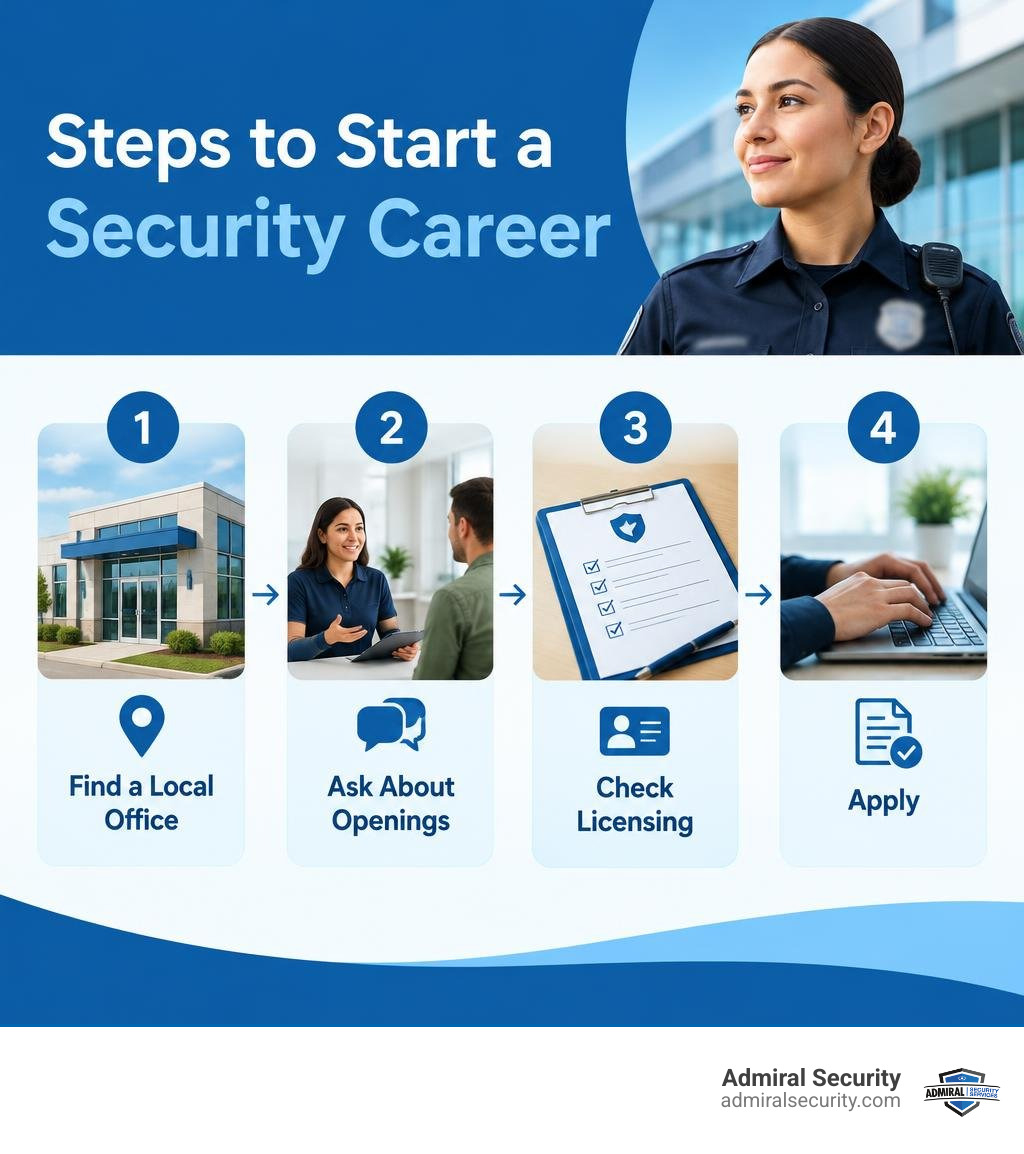
Nearby security guard office vocab explained:
How to Locate a Nearby Security Guard Office for Training and Deployment
When I started exploring the security industry, I realized quickly that finding the right physical branch makes all the difference. Security is an inherently hands-on, community-centered field. While you can browse open roles online, connecting with a physical branch anchors your professional journey.
To find the right location, start with geographic mapping tools and company directories. Admiral Security operates regional offices across major metropolitan hubs, including Bethesda and Baltimore, MD, Newport, DE, Richmond, Virginia Beach, Lynchburg, and Roanoke, VA, Raleigh and Greensboro, NC, Miami, Melbourne, Orlando, Tampa, and Sunrise, FL, Houston, Dallas, and Austin, TX, as well as Boston, MA. You can explore regional hubs directly through our locations directory.
Before you map out your route, ensure your digital profile and contact methods are accurate. If you use standard cloud suites or Google platforms to store your resume, completing basic account verification ensures you receive appointment confirmations and onboarding messages without delay. Once verified, call the branch to confirm recruitment hours before arriving for an interview or informational session.
Finding Career Opportunities at a Nearby Security Guard Office
Walking into a local office gives you immediate insight into company culture. Branch managers and recruiters handle everything from entry-level onboarding to state licensing paperwork. Instead of navigating confusing state regulatory portals alone, local recruiters guide you step by step.
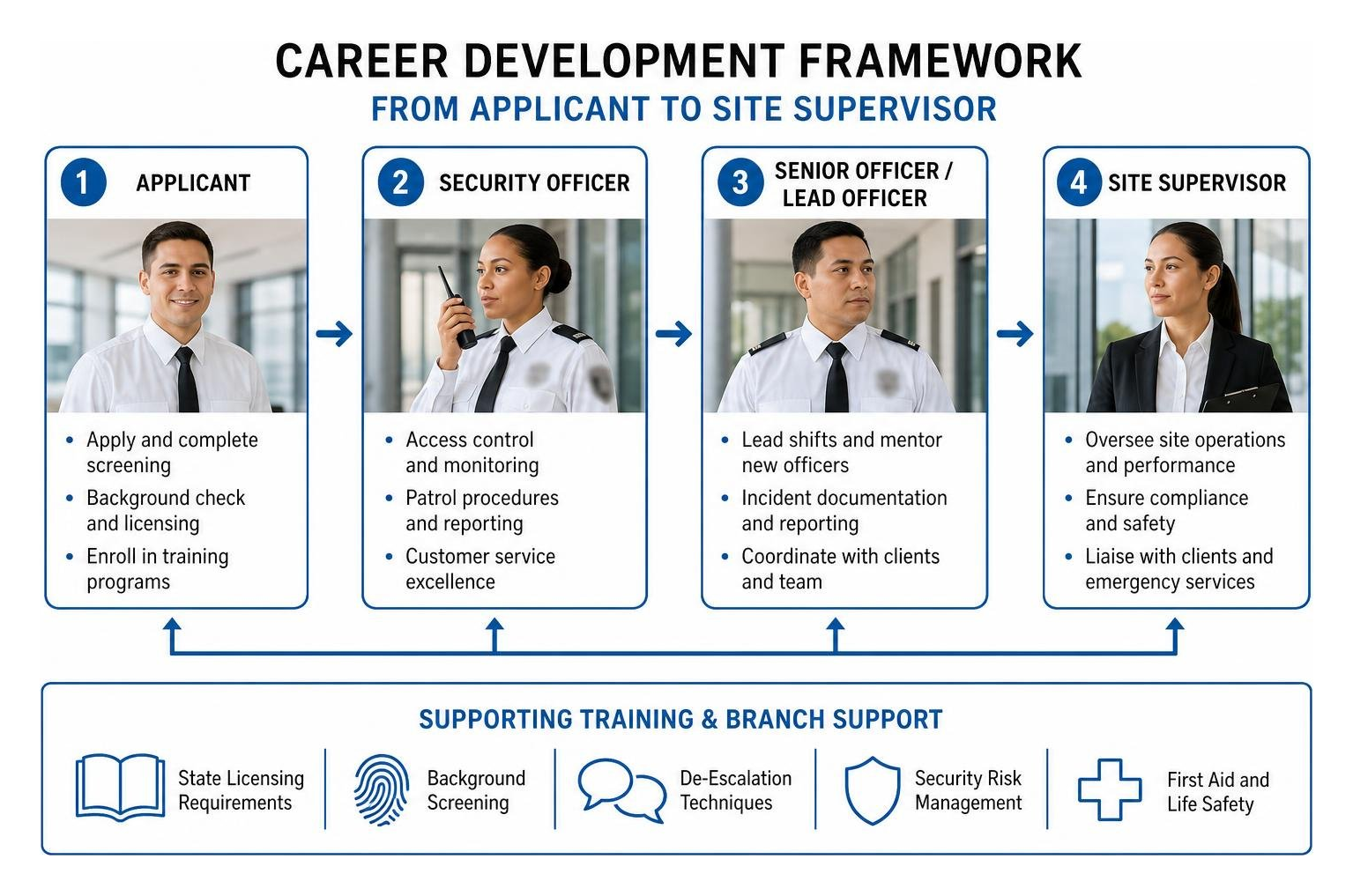
Starting your career with an established agency opens doors to structured career paths. You might begin at an entry-level concierge or corporate access post, but dedicated training helps you advance into supervisory roles, dispatch coordination, or security management. When you review the best local security officer agency options near you, prioritize organizations that invest in your ongoing development, offer consistent shift flexibility, and provide transparent advancement tracks.
Evaluating Local Branch Proximity and Operating Hours
Proximity matters for both staff and client sites. A local branch office coordinates day-to-day dispatch, schedules site relief, and provides responsive support to field personnel. When evaluating a branch, consider:
- Commute convenience for training modules, uniform pick-ups, and periodic performance reviews.
- 24/7 field supervision and support availability for overnight and weekend shifts.
- Active community presence across commercial districts, residential towers, and corporate parks.
Research shows that neighborhoods with a security office within 0.5 miles experience a 25% faster emergency response time on average. Proximity creates operational responsiveness, allowing branch supervisors to support officers on duty whenever unexpected situations occur.
Core Services and Training Programs Offered at Local Security Branches
A modern security branch acts as both an operational center and an educational academy. When you enroll in an in-house program, you learn the practical fundamentals of modern security operations.
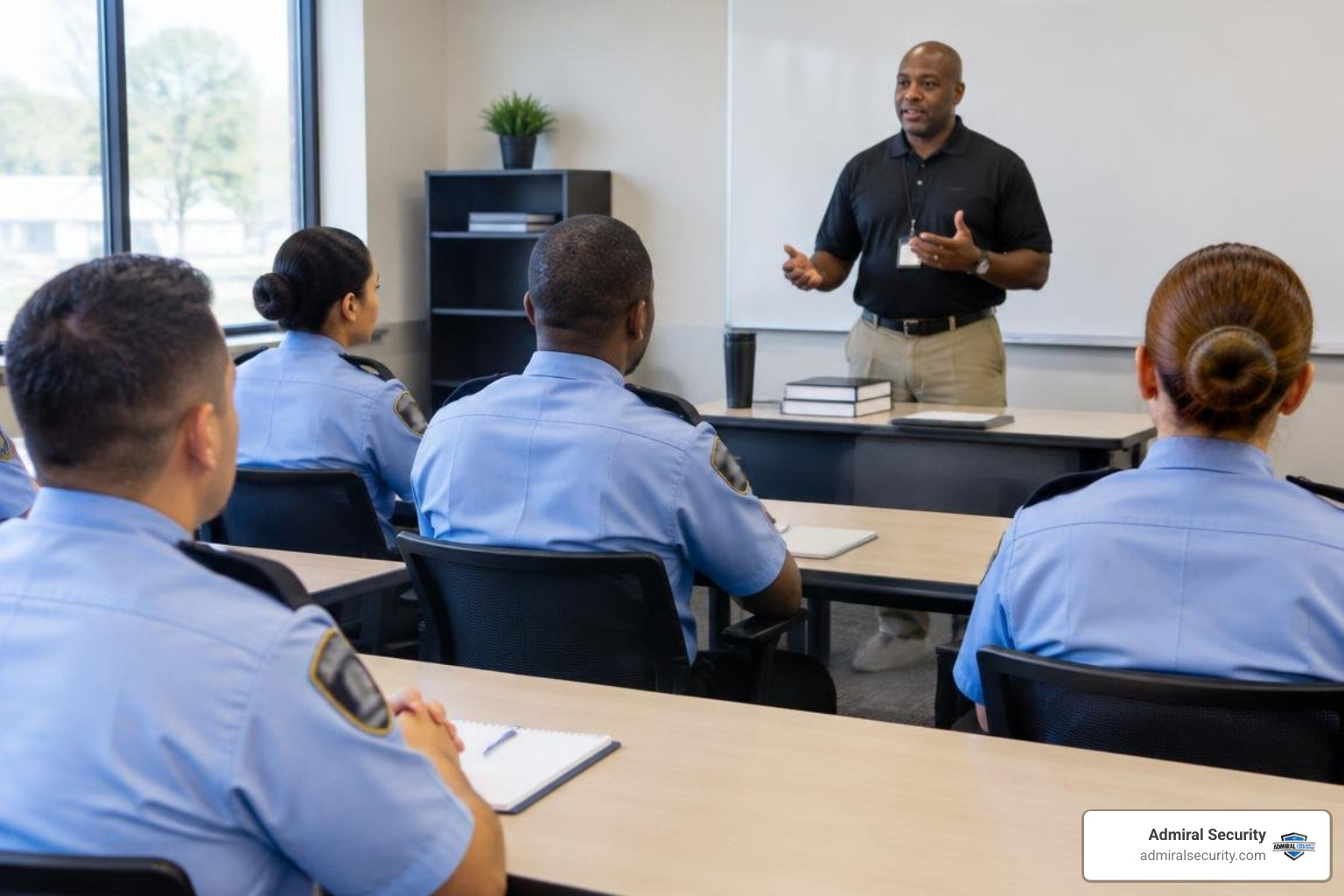
Courses cover access control management, customer service excellence, patrol procedures, incident documentation, and emergency response protocols. Clear communication forms the backbone of these programs. Officers learn to draft precise shift reports, communicate clearly over two-way radio networks, and handle visitors with professional courtesy.
Comprehensive Guard Training Programs and Certifications
State regulatory boards mandate specific training hours before issuing an official guard registration or license. A reputable branch simplifies this compliance process by providing accredited coursework that covers:
- State Licensing Requirements: Comprehensive review of legal boundaries, officer authority, and jurisdictional compliance.
- Background Screening: Complete support for biometric fingerprinting and criminal background verifications.
- De-Escalation Techniques: Practical verbal strategies to resolve workplace tension without physical conflict.
- Security Risk Management: Identifying vulnerabilities, maintaining physical perimeter controls, and spotting safety hazards.
- First Aid and Life Safety: CPR, AED operation, and basic first aid readiness.
On-Site Capabilities and Law Enforcement Collaboration
Security personnel serve as critical observers and liaisons on private property. While security officers do not replace public police forces, they work closely alongside local emergency services during critical incidents.
Branch managers maintain ongoing relationships with local police precincts, fire departments, and municipal emergency planners. In the field, officers provide clear incident logs, secure incident scenes for first responders, and manage building access during evacuations. For property managers, finding the best local security guards for your business ensures that on-site personnel are trained to deliver immediate, coordinated communication whenever first responders arrive.
How Local Security Guard Offices Impact Community Safety and Property Value
A dedicated security presence creates measurable benefits for surrounding neighborhoods and commercial corridors. The presence of a nearby security guard office can reduce local crime rates by up to 30% in some urban areas. Highly visible, uniformed personnel create an active deterrent against trespassing, vandalism, and unauthorized entry.
Commercial districts benefit significantly from nearby security operations. Approximately 70% of businesses report feeling safer when a security office is located within a 1-mile radius. Furthermore, over 60% of residents in communities near a branch report increased trust in local safety measures. These proactive measures help preserve neighborhood stability, and property values in areas with a security office within walking distance have been shown to increase by 5 to 10%.
Operational Standards and Security Guard Reliability
A security agency’s reputation rests on the reliability of its officers. Top branches maintain strict operational benchmarks through computerized post confirmation, random supervisory inspections, and recurring performance assessments.
You can often gauge branch standards by looking at community sentiment and local business reviews and safety data. High client retention and positive community feedback reflect an agency that prioritizes punctuality, sharp presentation, and meticulous execution of site-specific post orders.
Cost Structure and Compensation Factors
Understanding the financial side of security operations is essential for both aspiring officers and facility managers. For officers, many corporate agencies sponsor state licensing fees, provide uniforms at zero cost, and offer competitive hourly wages tied to site complexity.
For businesses planning their security budgets, understanding how to pick the best security guard provider in your neighborhood helps balance contract costs with service quality. Investing in a professional provider ensures officers receive living wages, comprehensive healthcare options, and extensive training, resulting in lower site turnover and higher service quality.
Steps to Launch Your Security Career at a Nearby Security Guard Office
Launching your career through a regional branch is straightforward when you follow a structured plan:
- Prepare Your Documentation: Gather your government-issued photo identification, social security card, proof of high school graduation or equivalent, and a clean driving record if applying for mobile patrol roles.
- Submit Your Application: Apply through the company career portal or attend an open hiring event at your local branch.
- Complete the Interview: Emphasize your communication reliability, customer service background, and attention to detail.
- Finish Required Classroom Hours: Complete state-mandated training, pass written exams, and submit fingerprints for background clearance.
- Complete On-Site Field Training: Shadow experienced officers at your assigned facility to master site-specific access systems, visitor policies, and patrol routes.
| Feature | Branch-Sponsored Office Program | Independent Security School |
|---|---|---|
| Upfront Tuition Costs | Often low or fully sponsored | High out-of-pocket costs |
| Job Placement | Direct placement upon licensing | Requires independent job search |
| Uniform & Gear Provision | Provided by employer | Must be purchased separately |
| Site-Specific Training | Included during onboarding | Generic theoretical curriculum only |
| Career Advancement Track | Clear internal promotion paths | No ongoing post-licensing support |
Frequently Asked Questions About Local Security Offices and Training
What qualifications are required to enroll in a local security guard program?
To enroll, you must generally be at least 18 years old (21 for certain specialized commercial accounts), possess a high school diploma or GED equivalent, and pass a comprehensive criminal background check and drug screening. Strong verbal and written English communication skills are essential for drafting incident reports and assisting building visitors.
How quickly can I get assigned after completing security training?
Placement typically occurs within one to two weeks following completion of required training hours, subject to state regulatory processing times. Once your provisional license or state guard card is issued, branch dispatchers match your schedule and skill set with active client assignments.
Do local security branches provide equipment and uniforms?
Yes, reputable agencies provide all standard duty uniforms, identification badges, high-visibility outerwear, and required communications gear such as two-way radios and digital patrol scanning devices during onboarding.
Conclusion
Starting your security career with an established agency gives you access to structured training, professional mentorship, and steady advancement opportunities. A dedicated regional branch provides the direct support, licensing assistance, and operational resources you need to succeed across corporate, healthcare, and commercial environments. To take your first step, find your nearest branch across the Admiral Security branch network and connect with our recruitment team today.