

Why a Security Patrol That Actually Moves Makes All the Difference
Mobile patrol security services use trained officers in marked vehicles to monitor your property at scheduled or random intervals, covering multiple sites per shift rather than staying fixed at one location.
Here’s what they include at a glance:
- Perimeter and access point checks at each visit
- Alarm response when a trigger is detected
- Lock and unlock services for opening and closing
- Parking lot and lighting assessments
- Real-time digital reporting with GPS verification
- Rapid dispatch to the nearest active incident
Nonresidential burglaries rose 5% in 2024 across 40 major U.S. cities, according to data from the Council on Criminal Justice. That trend has continued into 2026, and it puts real pressure on commercial real estate managers, retail operators, and facility teams to do more with tighter security budgets.
The challenge is straightforward. A static guard at one post cannot be in two places at once. But a roaming unit in a marked vehicle can cover 10 to 20 locations in a single shift, delivering a visible, professional presence across your entire property portfolio at a fraction of the cost of full-time on-site staffing.
That is the core promise of mobile patrol. It is not just a guard in a car. It is a flexible, technology-driven security approach designed to deter threats before they happen and respond fast when they do.
This guide walks you through exactly how it works, what to expect, and how to decide if it is the right fit for your properties.
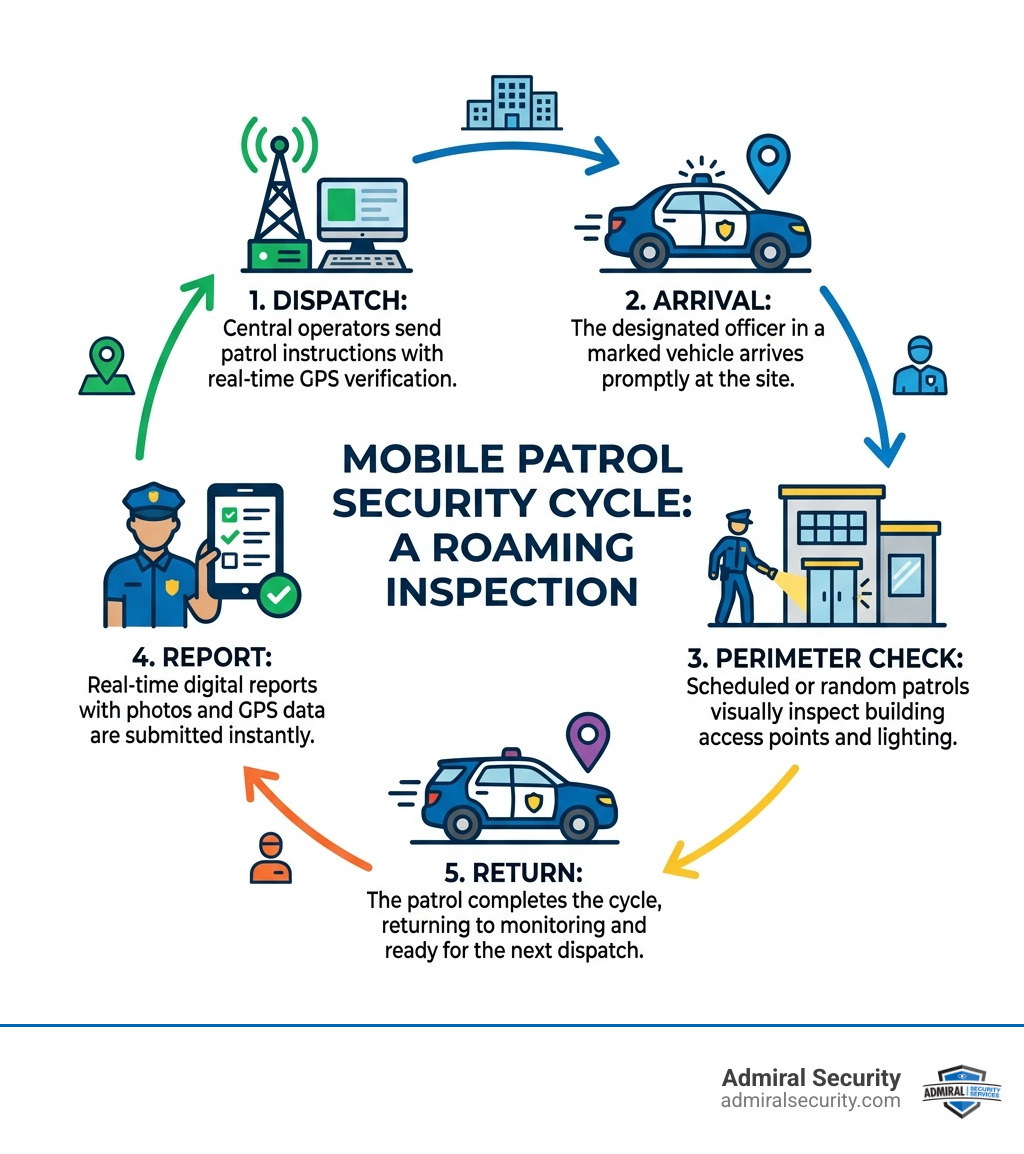
Mobile patrol security services terms you need:
The Strategic Benefits of Mobile Patrol Security Services
When I talk to business owners in cities like Richmond, Virginia Beach, or Houston, the conversation usually starts with one question: “How do I keep my property safe without spending my entire annual budget on a single guard post?” My answer is almost always the same. You need a presence that is visible, unpredictable, and highly mobile.
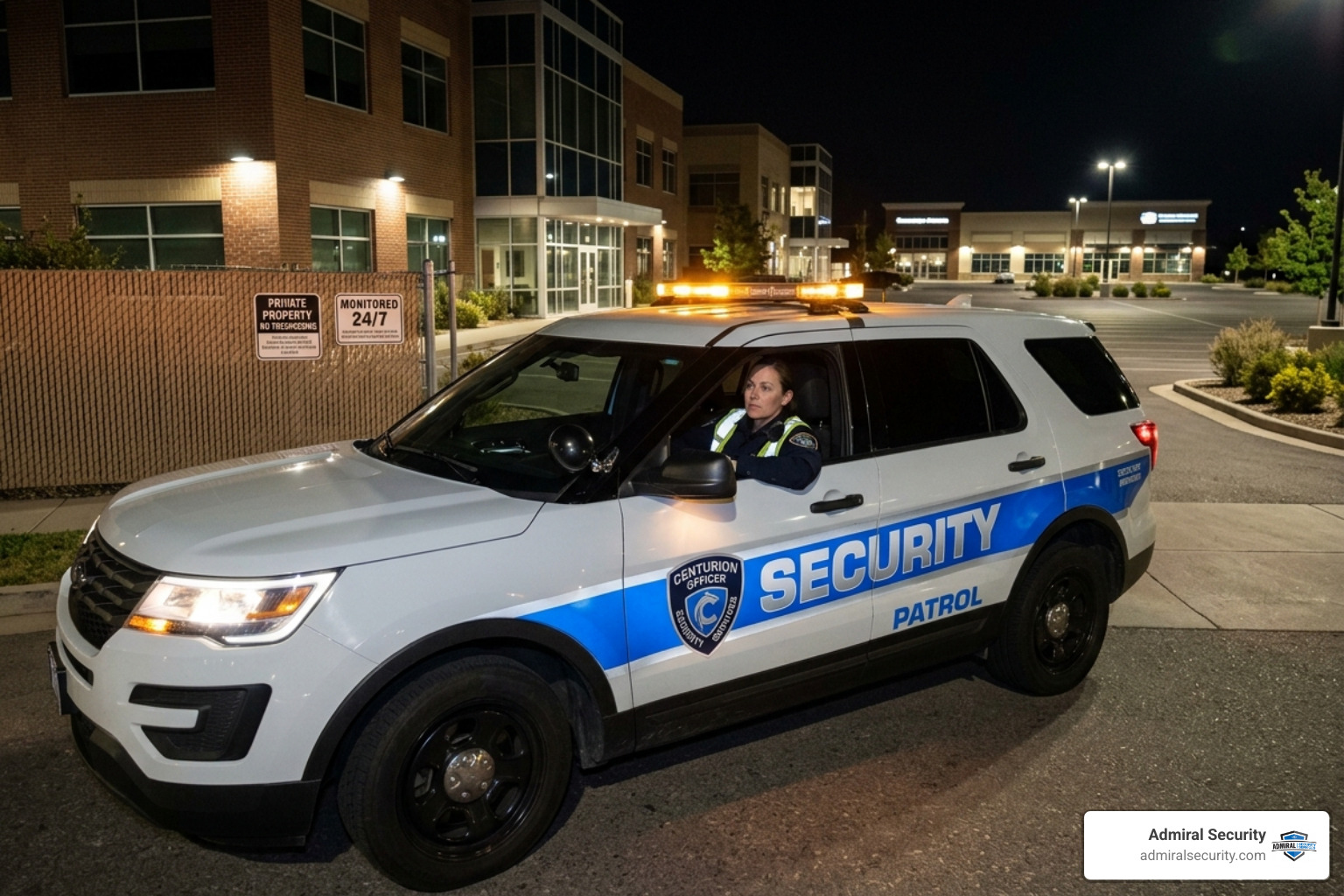
The most immediate benefit of mobile patrol security services is the psychological impact on potential intruders. A marked vehicle with professional lighting sends a clear message that the property is under active oversight. Because these patrols are often randomized, a criminal cannot simply wait for a guard to pass by on a fixed schedule. They never know when the next inspection will occur.
Cost-Effectiveness and Efficiency
In the current 2026 economic climate, efficiency is everything. Traditional security models often require a guard to sit at a desk or stand by a gate for eight to twelve hours. While this is necessary for some high-risk sites, many commercial properties only need a professional to verify that the building is secure, the gates are locked, and no unauthorized persons are on the premises.
By sharing the cost of a patrol vehicle with other nearby businesses, you gain the “Admiral Advantage” of professional oversight at a fraction of the cost. One vehicle can effectively cover a wide geographic area, making it a “wiser security investment” compared to older, static models.
Rapid Response and Deterrence
With the 5% rise in business burglaries reported in recent years, the speed of response is critical. When an alarm triggers at 2:00 AM in Bethesda or Orlando, you do not want to wait for a supervisor to drive across the state. Mobile units are already on the road. They are often the first responders to a scene, capable of stabilizing a situation until law enforcement arrives.
For more information on how we maintain a constant presence, you can explore our Top Rated 24 Hour Security Guards to Keep Your Property Safe or learn more about our specific Mobile Patrol Security Services.
How Roaming Units Differ from Static Guarding
It is a common misconception that all security is the same. In reality, choosing between a static guard and a mobile patrol is about matching the resource to the risk. I like to think of static guards as the “anchor” and mobile patrols as the “scouts.”
| Feature | Mobile Patrol Security Services | Static Guarding |
|---|---|---|
| Coverage Area | Multiple sites or large perimeters | Single fixed post or building |
| Cost Structure | Shared/Fractional (Lower cost) | Dedicated (Higher cost) |
| Primary Tool | Marked vehicles/GPS technology | Physical presence/Access control |
| Scheduling | Randomized or interval-based | Continuous 24/7 or shift-based |
| Scalability | High (Easy to add/remove stops) | Medium (Requires more personnel) |
Coverage and Scalability
Static guards are excellent for high-traffic areas like hospital lobbies in Miami or corporate headquarters in Boston where constant access control is required. However, for a warehouse in Greensboro or a retail strip in Tampa, a static guard might spend hours with nothing to do.
Mobile patrols solve this by offering a shared coverage model. The officer moves from one client site to the next, performing deep-dive inspections at each stop. This allows for better resource allocation, ensuring you only pay for the security you actually need. Our Uniformed Personnel are trained to transition between these roles seamlessly, providing the same level of professionalism whether they are at a fixed post or in a patrol vehicle.
Versatility in Action
The beauty of a roaming unit is its ability to handle multiple tasks that a static guard simply cannot. A mobile officer can check the back alley of a property, drive through a dark parking garage, and then head to a second location three miles away to perform a lock-up service. This versatility makes Mobile Patrol Security Services and Alarm Response a powerhouse for property managers with diverse portfolios.
Operational Standards for Mobile Security
What actually happens when a patrol vehicle pulls into your lot? It is not just a “drive-by.” At Admiral Security, we follow strict operational standards to ensure every visit provides real value.
Randomized Scheduling
If I were a criminal, the first thing I would do is time the security guard. If I know the guard walks the fence at exactly 10:15 PM every night, I know exactly when to strike. This is why randomization is our best friend. By varying the arrival times and routes, we maintain the upper hand. The goal is to make it impossible for anyone to predict when the next inspection will happen.
Alarm Response Protocols
When an alarm system triggers, a mobile unit is often the most logical choice for response. Because our vehicles are GPS-tracked, our dispatch center can identify the nearest officer and redirect them immediately. This reduces the risk of property damage and provides a physical presence to verify if a threat is real or a false alarm, saving you from potential municipal fines. You can read more about how we link these systems in our Integration Monitoring section.
Lock and Unlock Services
Many of our clients in cities like Dallas and Austin use mobile patrols to manage the “opening and closing” of their facilities. This removes the burden from your employees, who may not want to be the last person leaving a dark building at night. A patrol officer can perform a final sweep, ensure all doors are secured, and set the alarm, providing a “safe walk” for staff if needed.
Essential Tasks Performed During Mobile Patrol Security Services
During a typical inspection, an officer is looking for more than just intruders. We are looking for anything that could compromise the safety of the property.
- Door and Window Checks: Physically verifying that all entry points are locked and show no signs of forced entry.
- Perimeter Controls: Checking fences, gates, and walls for gaps or damage.
- Lighting Assessments: Identifying burnt-out bulbs in parking lots or stairwells that could create “blind spots” for crime.
- Parking Lot Oversight: Checking for unauthorized vehicles, loitering, or signs of vagrancy.
- Hazard Identification: Acting as a second set of eyes for safety issues like leaking pipes, fire hazards, or tripping risks.
This proactive approach to Security Risk Management ensures that we are addressing vulnerabilities before they turn into costly incidents.
Leveraging Technology for Transparent Mobile Patrol Security Services
In the old days, you had to trust that a guard actually visited your property. Today, we use data to prove it. Technology has completely transformed how we deliver these services.
- GPS Tracking: Every patrol vehicle is equipped with GPS, allowing us to provide a digital audit trail of exactly when the vehicle entered and exited your property.
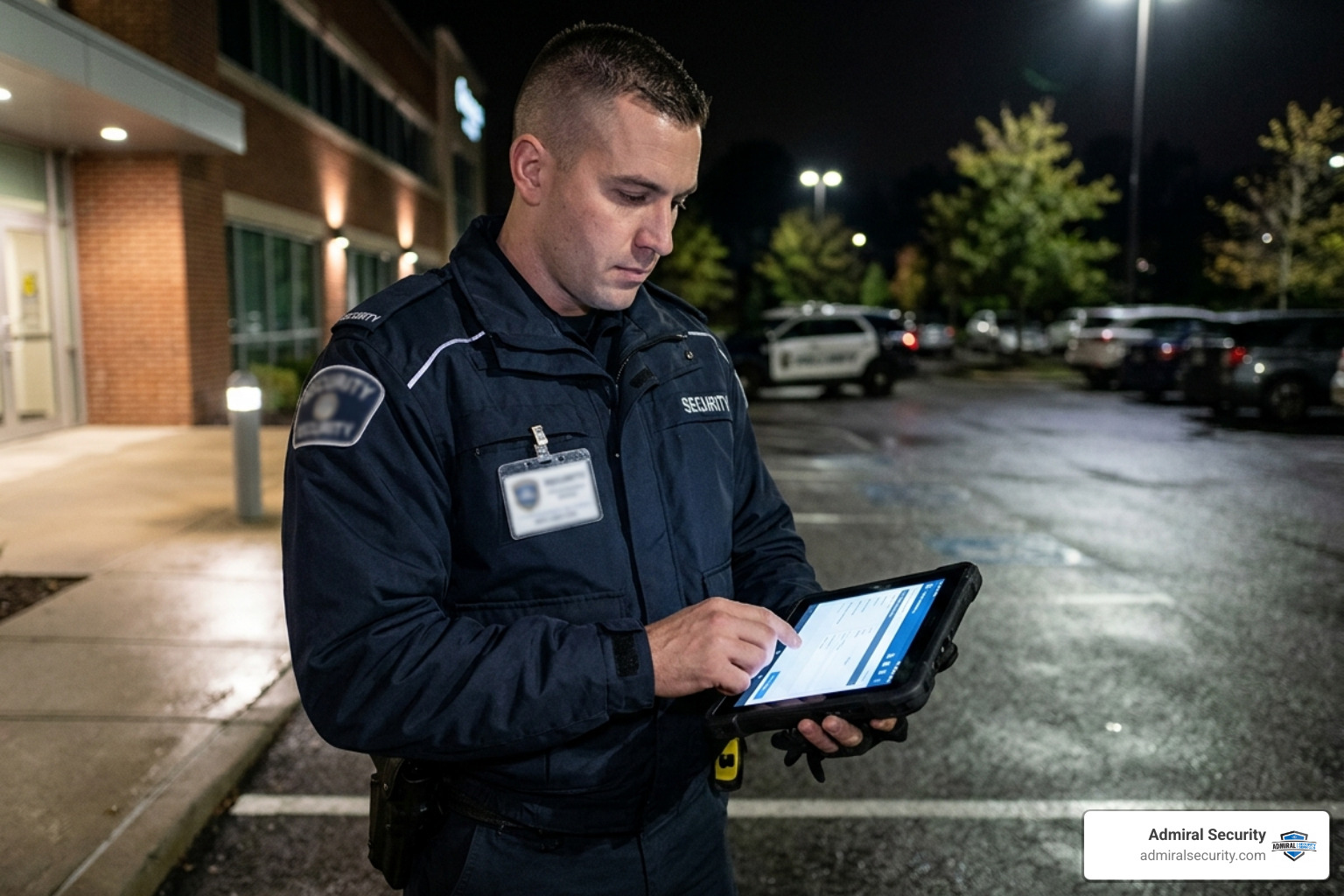
- Digital Reporting: Officers use handheld devices to document their findings in real-time. If they find a broken window, they take a photo, tag the location, and upload it to a portal you can access instantly.
- Geolocation Verification: Our systems ensure that an officer must be within a specific distance of a “checkpoint” to log an inspection, providing total accountability.
Our commitment to Technology means you never have to guess if your property is being watched. You have the data to back it up.
Frequently Asked Questions about Mobile Patrols
How cost-effective are mobile patrols compared to full-time guards?
Mobile patrols are significantly more affordable for most businesses. Instead of paying for 168 hours of labor per week for a 24/7 static guard, you pay for a set number of daily or nightly visits. This can often save a business thousands of dollars a month while still providing a high-visibility deterrent and professional response capability.
Can mobile patrol officers handle emergency alarm responses?
Yes. In fact, this is one of their primary functions. Because they are already mobile and equipped with communications gear, they can often reach a site faster than a stationary supervisor could. They are trained to assess the risk, secure the perimeter, and coordinate with local emergency services as needed.
What industries benefit most from roaming security services?
While almost any business can benefit, we see the highest impact in:
- Commercial Real Estate: Office parks and business centers that need after-hours checks.
- Construction Sites: Monitoring expensive equipment and materials overnight.
- Retail Centers: Deterring loitering and vandalism in parking areas.
- Residential Communities/HOAs: Providing a sense of safety for residents through visible patrols.
- Healthcare and Education: Managing large campuses where foot patrols are insufficient.
Conclusion
At Admiral Security, I believe that security should be as dynamic as the threats it aims to stop. Whether you are managing a retail hub in Sunrise, Florida, or a corporate complex in Newport, Delaware, your property deserves a strategy that combines logic, empathy, and high-tech responsiveness.
The “Admiral Advantage” is about more than just cars and uniforms. It is about building trust through transparency and ensuring that every time one of our officers blurs their badge and steps out of a vehicle, they are focused on the safety of your assets.
If you are ready to move away from passive surveillance and toward a proactive, mobile solution, I encourage you to look at our various Locations and see how we can tailor a program for you. We are not just watching your property; we are moving with it.