

Should You Hire a Security Guard for Your House?
To hire a security guard for your house, I recommend starting with the hours you need covered and the areas that concern you most. Ask a security company to walk the property, then compare written plans. Before signing, check licensing, insurance, staffing plans, and how the guard will work with your cameras and alarms.
A guard can screen visitors, watch entrances, and respond to incidents on site. The tradeoffs are ongoing cost, household privacy, and the need for reliable coverage. I would weigh those against your home’s risks before choosing full-time staffing.
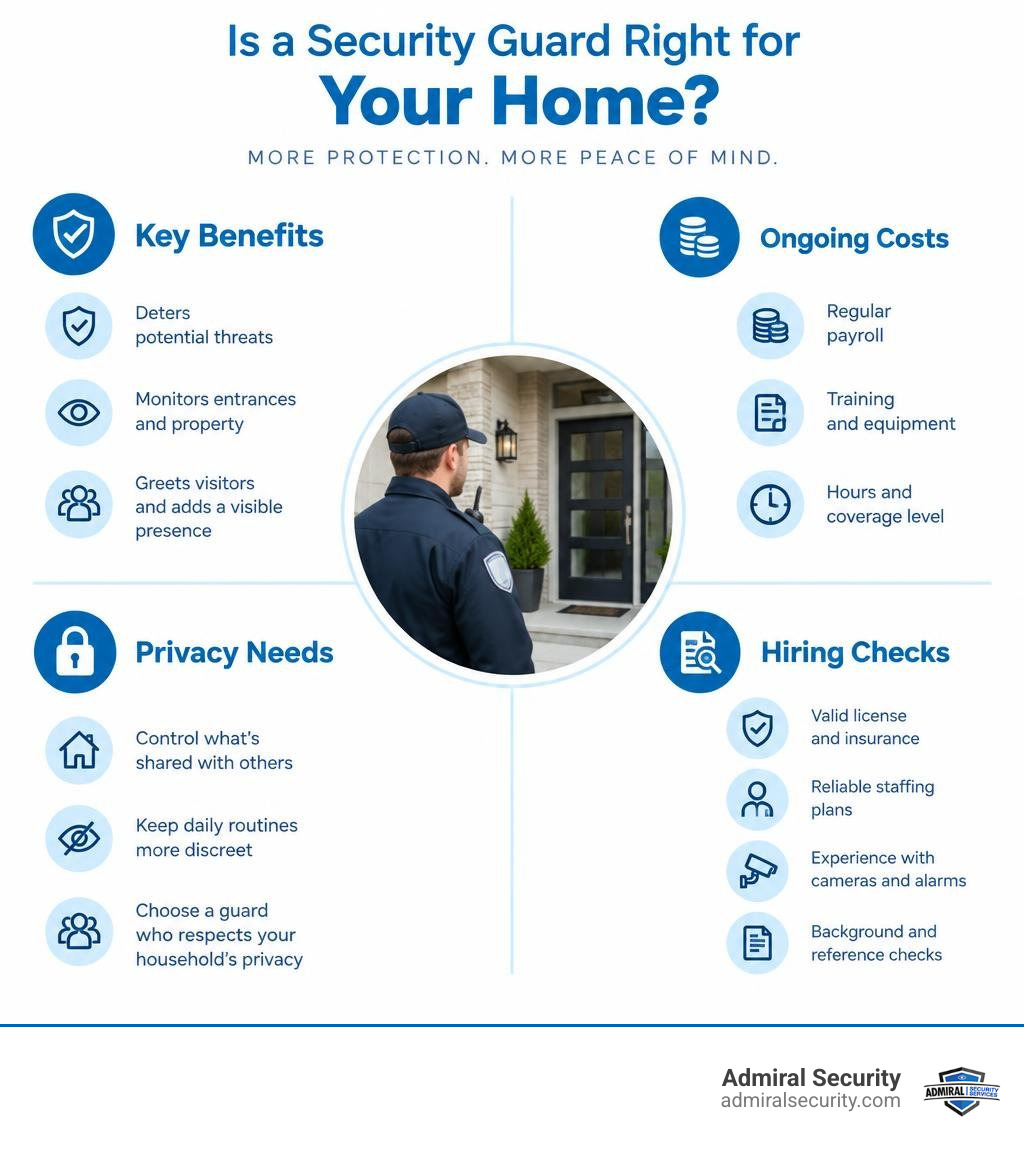
Must-know hire security guard for house terms:
- home security officers
- security guard for hire
- vetted security officers
Evaluating the Pros and Cons of Residential Security Personnel
When I evaluate physical security solutions for private residences, having dedicated personnel on site stands out as a powerful deterrent. Electronic alarm sensors and surveillance cameras provide valuable visibility, yet they cannot physically step in to challenge an unauthorized visitor, manage a perimeter breach, or inspect a suspicious vehicle idling at your driveway gate. Understanding why residential security officer services are your best defense involves balancing visible crime deterrence against ongoing financial commitments and personal lifestyle adjustments.
Advantages: Deterrence, Rapid Response, and Access Control
The primary advantage of on-site security personnel is immediate, visible deterrence. An alert, uniformed officer stationed at your gatehouse, driveway, or front entryway discourages opportunistic trespassers, package thieves, and organized intruders long before they reach an entry door.
Beyond deterrence, on-site personnel deliver practical operational benefits:
- Strict Access Control: Officers screen incoming delivery drivers, contractors, service technicians, and unexpected visitors, verifying credentials before granting access to your grounds.
- Immediate Incident De-escalation: If an unauthorized person enters the property, an officer can address the situation right away, issue verbal trespass warnings, and manage the event before it escalates.
- Active Perimeter Surveillance: Scheduled and randomized foot rounds ensure that perimeter fencing, exterior lighting, detached garages, and rear patio access points remain secure.
- Property Value Support: Consistent access oversight and property maintenance logging help prevent vandalism, trespassing, and property degradation, supporting long-term neighborhood value.
Disadvantages: Ongoing Costs and Privacy Considerations
Despite these substantial benefits, dedicated residential personnel require clear tradeoffs that every homeowner must consider:
- Recurring Financial Investment: Maintaining round-the-clock physical security coverage is one of the largest ongoing property management expenses, requiring a continuous budget for hourly billing or payroll.
- Adjustments to Household Privacy: Having security staff stationed on your grounds means non-family personnel are regularly present near your living spaces, entryways, and driveways.
- Operational Management: If you attempt to hire guards directly rather than contracting an established agency, you must handle scheduling, relief coverage for sick days, payroll withholding, and performance supervision yourself.
- Direct Employer Liability: Employing an independent contractor without substantial insurance coverage exposes you to personal liability for property damage or workplace injury claims.
How to Hire a Security Guard for Your House: Step-by-Step Guide
Securing professional personnel for your home requires structured planning. I always advise homeowners to follow a methodical approach to ensure that the personnel deployed to their residence meet strict professional standards.
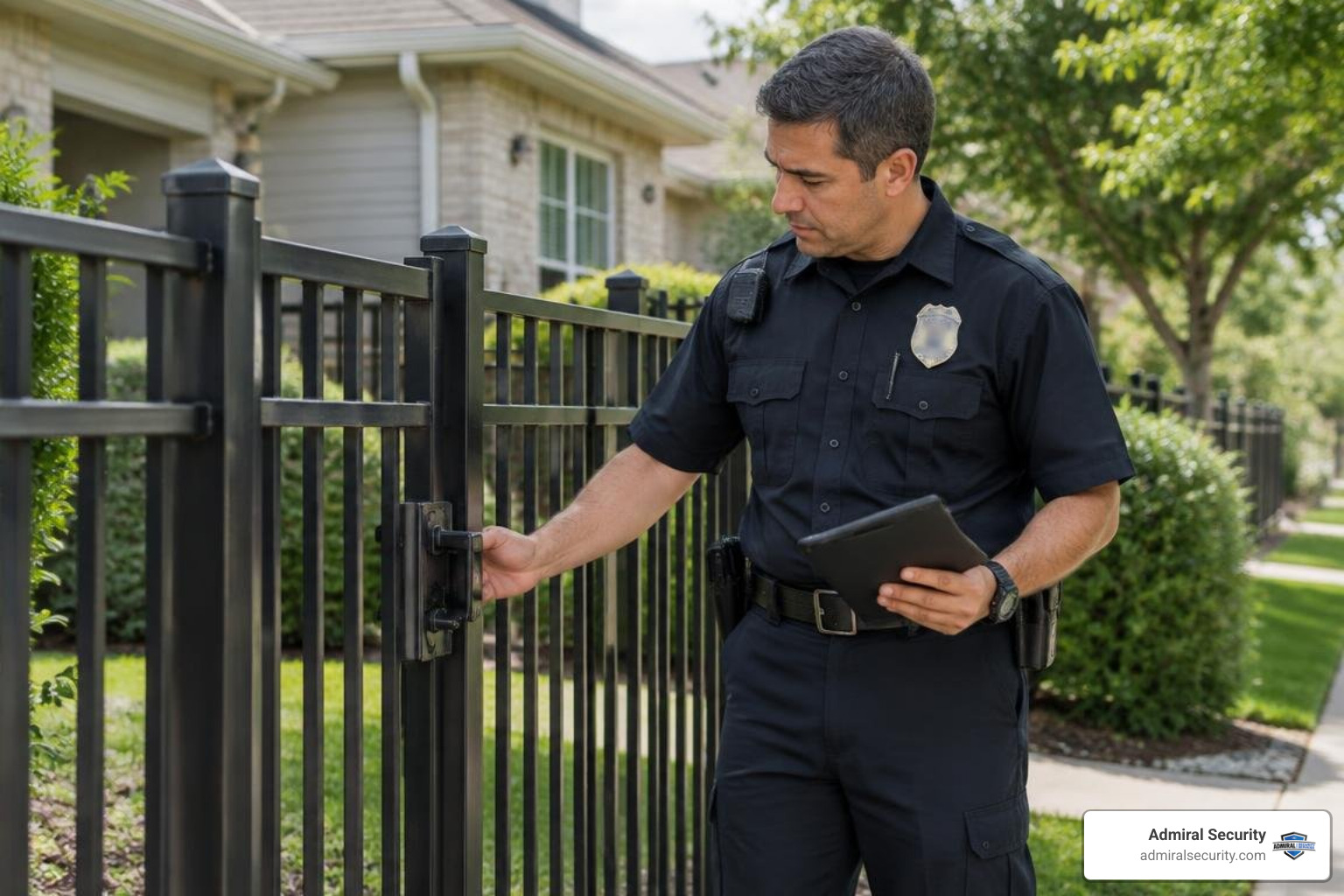
Initial Steps to Hire a Security Guard for Your House
When you decide to move forward, following a clear step-by-step framework saves time and avoids costly security oversights.

- Define Your Coverage Requirements: Determine whether your property requires continuous 24/7 dedicated staffing, overnight coverage during peak vulnerability windows, or temporary gate monitoring during construction or high-profile private events.
- Contact Licensed Security Agencies: Reach out to established private security firms that maintain operations in your region. Working with specialized providers ensures access to trained, background-checked personnel.
- Conduct an On-Site Vulnerability Walkthrough: Have an operational security manager visit your property to evaluate physical layout, blind spots, perimeter fencing, gate systems, and exterior lighting.
- Review Tailored Service Proposals: Examine formal bids detailing staffing levels, supervisor oversight, post orders, relief shift schedules, and transparent hourly billing rates.
- Execute a Service Contract: Finalize a formal agreement detailing standard operating procedures, non-disclosure confidentiality terms, emergency communication protocols, and liability indemnification.
Assessing Residential Security Vulnerabilities and Needs
A proper residential plan begins with a comprehensive security risk management review. Homes vary significantly in their architecture and vulnerabilities. A private estate situated on several open acres in Baltimore or Richmond requires a different security posture than a zero-lot-line residence in Miami or Boston.
During an initial property assessment, I evaluate several key structural variables:
- Perimeter Boundaries: Inspecting tree lines, perimeter walls, access gates, and alleyways for natural concealment zones.
- Primary and Secondary Entry Points: Evaluating gate locks, exterior door hardware, service entries, and basement walkouts.
- Line-of-Sight and Lighting: Identifying shadowed exterior zones and blind spots that cannot be viewed easily from indoor living areas or smart cameras.
- Neighborhood Incident History: Reviewing regional crime trends, recent trespass patterns, and local emergency response windows.
Security Agency vs. Independent Contractor
Homeowners frequently ask whether they should hire an individual security contractor directly or partner with an established security firm. Reviewing key guidance on finding trusted security service providers clarifies why direct-hire models carry hidden operational risks.
| Evaluation Factor | Professional Security Agency | Independent Security Contractor |
|---|---|---|
| Staffing Continuity | Guaranteed shift coverage, automated relief staffing, and backup dispatch | Zero built-in backup when the worker is ill, injured, or takes time off |
| Supervision & Quality Control | Dedicated field supervisors, 24/7 operations dispatch, and GPS patrol logging | Homeowner must personally supervise, manage time sheets, and enforce post orders |
| Insurance & Liability | Comprehensive General Liability, Workers’ Comp, and umbrella policies included | Homeowner often absorbs premises liability, injury exposure, and tax compliance |
| Vetting & Screening | Multi-jurisdiction background checks, license verification, and ongoing drug screening | Homeowner must independently verify credentials, criminal histories, and driving records |
| Onboarding Speed | Immediate deployment of fully vetted and equipped personnel | Lengthy recruitment, vetting, and interview cycles managed by the homeowner |
Cost Considerations and Budgeting for Residential Guard Services
Budgeting for residential security personnel requires an understanding of hourly billing structures and the operational factors that determine base rates.
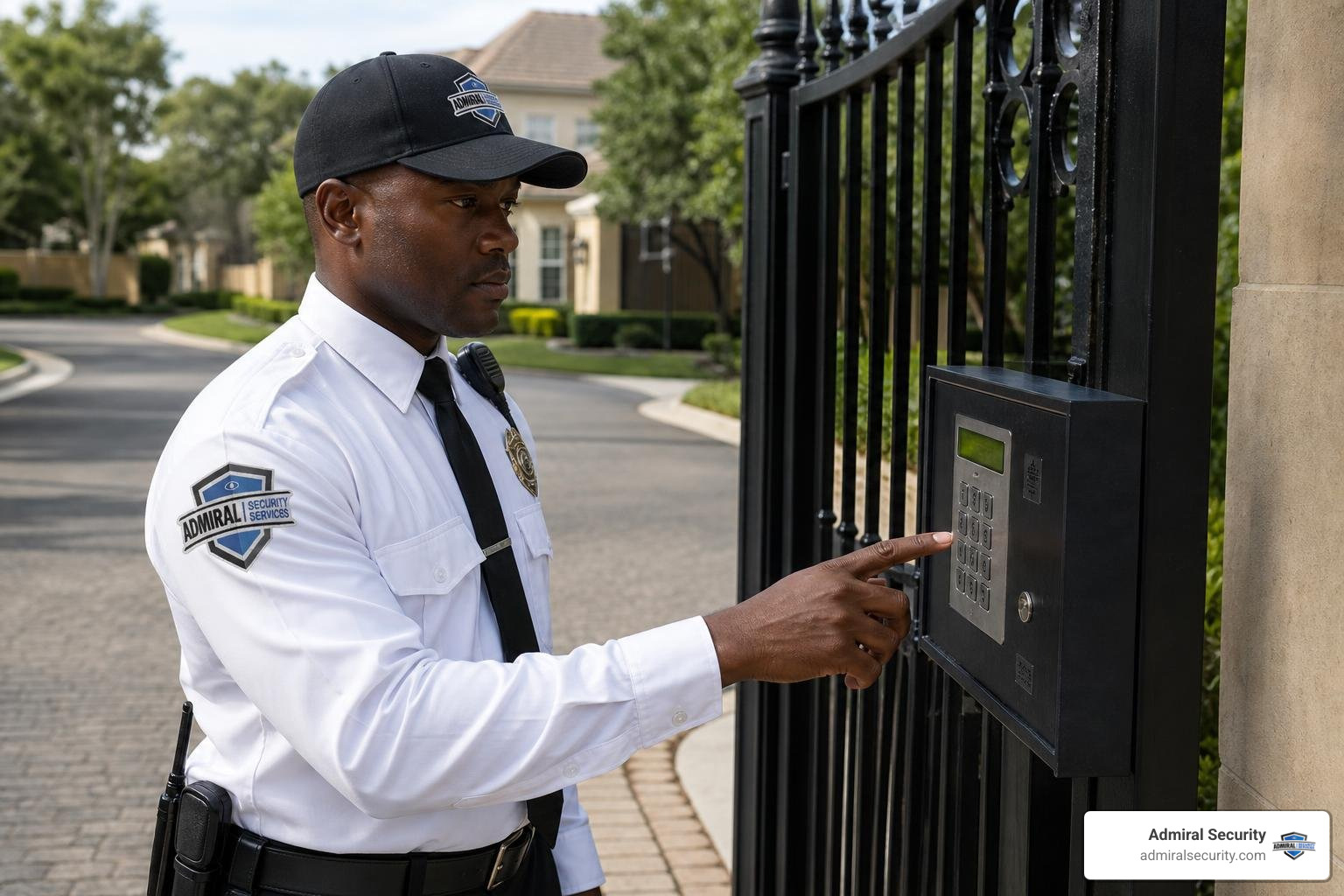
Across the Mid-Atlantic region of the United States, including major hubs in Maryland and Virginia, hourly rates for standard residential security guard services generally range from $26 to $50 per hour, per officer. In high-density metropolitan markets, billing rates average around $35 per hour for dedicated unarmed personnel.
Because continuous 24/7 staffing requires roughly 4.2 full-time equivalent guards to account for shifts, meal breaks, and weekends, homeowners must budget realistically for round-the-clock physical presence.
Key Factors that Influence the Cost to Hire a Security Guard for Your House
Several site-specific variables drive the final hourly rate quoted by reputable security firms:
- Geographic Location and Market Demand: Labor rates, regulatory compliance costs, and regional overhead in cities like Boston, Miami, Dallas, or Houston impact base service rates.
- Risk Level and Post Complexity: Standard gate access control and visitor logging carry lower billing rates than high-risk residences that demand advanced perimeter foot patrols and rapid threat de-escalation.
- Specialized Qualifications: Officers possessing extensive tactical training, executive security backgrounds, or specialized access management certifications command premium rates.
- Coverage Duration and Short-Notice Requests: Long-term annual service agreements receive stable, predictable hourly rates, whereas emergency, same-day deployments or short-term holiday coverage involve higher billing premiums.
Essential Vetting Criteria, Licensing, and Legal Standards
Entrusting individuals with the safety of your private residence demands strict adherence to regulatory standards. You must never compromise on professional credentials. Emphasizing hiring vetted security officers ensures your household is served by qualified professionals.
Verifying State Licenses, Insurance, and Background Checks
Every state maintains specific licensing and regulatory frameworks governing private security companies and individual security officers. For instance, security agencies operating in New York must hold a Watch, Guard, or Patrol Agency license issued by the Department of State. Similar regulatory oversight bodies govern guard credentials across Delaware, North Carolina, Florida, Texas, and Massachusetts.
Before signing any service agreement, insist on verifying:
- Active State Agency License: Confirm that the security provider holds a valid corporate security contractor license in your state.
- Individual Guard Registrations: Verify that every officer assigned to your home has completed mandatory state training courses (such as basic pre-assignment training and annual in-service updates) and holds an active guard card.
- Comprehensive Background Checks: Review the firm’s screening procedures. Demanding background checked security guards means ensuring criminal history checks, motor vehicle records, and drug screenings have been completed.
- Insurance Coverage Limits: Demand a Certificate of Insurance listing you as an additional insured. The company must carry substantial Commercial General Liability, Errors and Omissions, and statutory Workers’ Compensation coverage.
Understanding Guard Legal Authority and Jurisdiction
A private security officer on residential property operates under specific legal boundaries. Private security personnel do not possess municipal law enforcement authority or special police powers. Their legal authority mirrors that of a private citizen under state statutes.
Their primary operational mission focuses on:
- Observation, Detection, and Reporting: Identifying potential hazards, equipment failures, suspicious loitering, and perimeter breaches.
- Enforcing Private Property Access Rules: Directing unauthorized individuals to leave the grounds and denying entry to unverified visitors.
- Citizen’s Detention Limitations: In cases of severe felony offenses committed in their presence, officers may perform a citizen’s arrest, but standard operating procedures emphasize de-escalation, containment, and immediate emergency coordination with municipal police departments.
Integrating Personnel with Home Alarms and Surveillance Systems
On-site security personnel operate at peak efficiency when integrated with your home’s electronic safety infrastructure. A dedicated residential guard can:
- Acknowledge and Clear False Alarms: Quickly verify automated alerts triggered by pets, wind, or landscaping crews, preventing costly municipal false alarm fines.
- Monitor Real-Time Camera Feeds: Observe perimeter cameras from a gatehouse or security station, tracking blind spots before conducting exterior rounds.
- Manage Smart Gate Systems: Coordinate electronic access control, intercom communication, and temporary visitor codes directly from an integrated console.
Frequently Asked Questions About Residential Security Guards
What is the average hourly cost for a residential security guard?
In the Mid-Atlantic and East Coast markets, professional unarmed residential security officers typically cost between $26 and $50 per hour through an established agency, with standard metropolitan rates averaging approximately $35 per hour. Specialized personnel or high-complexity assignments command higher rates.
What is the difference between unarmed and armed security guards for residential properties?
Unarmed officers complete basic state-mandated security instruction, access control procedures, emergency reporting, and conflict de-escalation training. They are ideal for standard residential gatekeeping, visitor screening, and perimeter rounds. Officers authorized for armed roles must complete extensive supplemental firearms training, qualification courses, and permit verification. For the vast majority of single-family residences, thoroughly trained unarmed officers provide robust deterrence and access management without the added legal liabilities associated with firearms on residential grounds.
Can a residential security guard make an arrest on my property?
A private security guard holds the legal authority of a private citizen under state law. They cannot issue official citations or execute warrants. If an intruder commits a serious crime or refuses to leave private property after being told to do so, an officer can detain the individual using reasonable, non-deadly force until local law enforcement arrives on scene to take official custody.
Conclusion
Deciding whether to station dedicated personnel at your private home requires a balanced analysis of your property’s specific vulnerabilities, your budget, and your lifestyle preferences. While physical security officers represent an ongoing financial investment, their ability to provide active deterrence, manage vehicle access, and respond immediately to unexpected perimeter events remains unmatched by cameras and sensors alone.
By performing a detailed security risk management review, checking state licensing and insurance credentials, and partnering with experienced uniformed personnel, you create a safe, controlled living environment. If you want to elevate your home’s safety posture, explore tailored residential staffing solutions with Admiral Security to design a dedicated security plan built around your property’s exact footprint.