

Core Categories of Uniformed Officers Across Public and Private Sectors
Understanding who stands before you begins with recognizing their jurisdiction, legal authority, and primary mission. Every tier of uniformed service fulfills a distinct role in maintaining order and visual deterrence.
| Officer Category | Primary Jurisdiction | Legal Authority | Core Mission |
|---|---|---|---|
| Federal Law Enforcement | Specific federal properties, borders, and national assets nationwide | Statutory federal authority; enforces federal laws and safeguards designated sites | Facility defense, asset security, and federal law enforcement |
| State Police / Highway Patrol | Statewide; focus on state highways and unincorporated county areas | State statutory authority; enforces state criminal and traffic statutes | Highway traffic management, statewide emergency assistance, and rural support |
| Municipal Police | Incorporated city, town, or transit system boundaries | Municipal and state law enforcement authority | Community safety, calls for service, local traffic, and neighborhood presence |
| Non-Combat Uniformed Services | National / global; detailed to scientific, health, or maritime operations | Title 10 & Title 42 statutory frameworks; specialized administrative authority | Public health response, environmental science, and maritime charting |
| Private Security Personnel | Assigned private properties, commercial facilities, and campuses | Private property access control, premises rule enforcement, and citizen authority | Visual deterrence, visitor management, access screening, and asset monitoring |
Federal Law Enforcement and Security Details
Federal uniformed personnel operate under direct congressional mandates to safeguard critical national infrastructure. A prominent example is the U.S. Secret Service Uniformed Division, which has provided physical security across key government sites for over 150 years.
These officers hold statutory mandates to safeguard the White House Complex, the Vice President’s residence at the Naval Observatory, the main Treasury Department building, and foreign diplomatic missions throughout Washington, D.C. Prospective recruits can review the specific duties of a Uniformed Division Officer to learn how these officers execute facility defense and access screening.
State Police and Municipal Patrol Personnel
State police and highway patrol agencies enforce traffic laws on state routes and assist local agencies during major incidents. In municipal environments, local departments maintain public order within city borders.
In major urban centers, municipal departments handle massive operational footprints. For example, the NYPD employs roughly 33,000 officers and 15,000 civilian staff, managing 78 patrol precincts, 12 transit districts, and 9 police service areas. Other regional agencies, such as the Montgomery County Police Department, Baltimore Police Department: Homepage, Police | Richmond, Police | City of Virginia Beach, and Roanoke Police Department, deploy municipal patrols to handle local calls, manage traffic flow, and build community relationships.
Distinguishing Federal Uniformed Officers from Military Services
The United States maintains eight distinct uniformed services defined under 10 U.S.C. §101(a)(5). These services encompass the six armed forces: the Army, Marine Corps, Navy, Air Force, Space Force, and Coast Guard. The armed forces maintain over 1,374,125 active personnel, representing the third-largest military force globally.
The remaining two branches are non-combatant, non-armed uniformed services:
- The Public Health Service Commissioned Corps (PHSCC): Led by the Surgeon General under the Department of Health and Human Services, delivering medical and public health response.
- The National Oceanic and Atmospheric Administration (NOAA) Commissioned Officer Corps: Operating under the Department of Commerce, managing scientific vessels and environmental research aircraft.
Officers in the PHSCC and NOAA Corps wear navy-style uniforms with service-specific insignia, but they do not serve as combatants or law enforcement agents. Under presidential executive order, however, their personnel can be integrated into armed forces operations during national emergencies.
Commercial Guarding and Private Security Patrols
Private sector operations rely on dedicated personnel to preserve site integrity, control entry points, and support facility operations. Unlike sworn law enforcement, private officers focus on the physical boundaries and procedural standards of specific client sites.
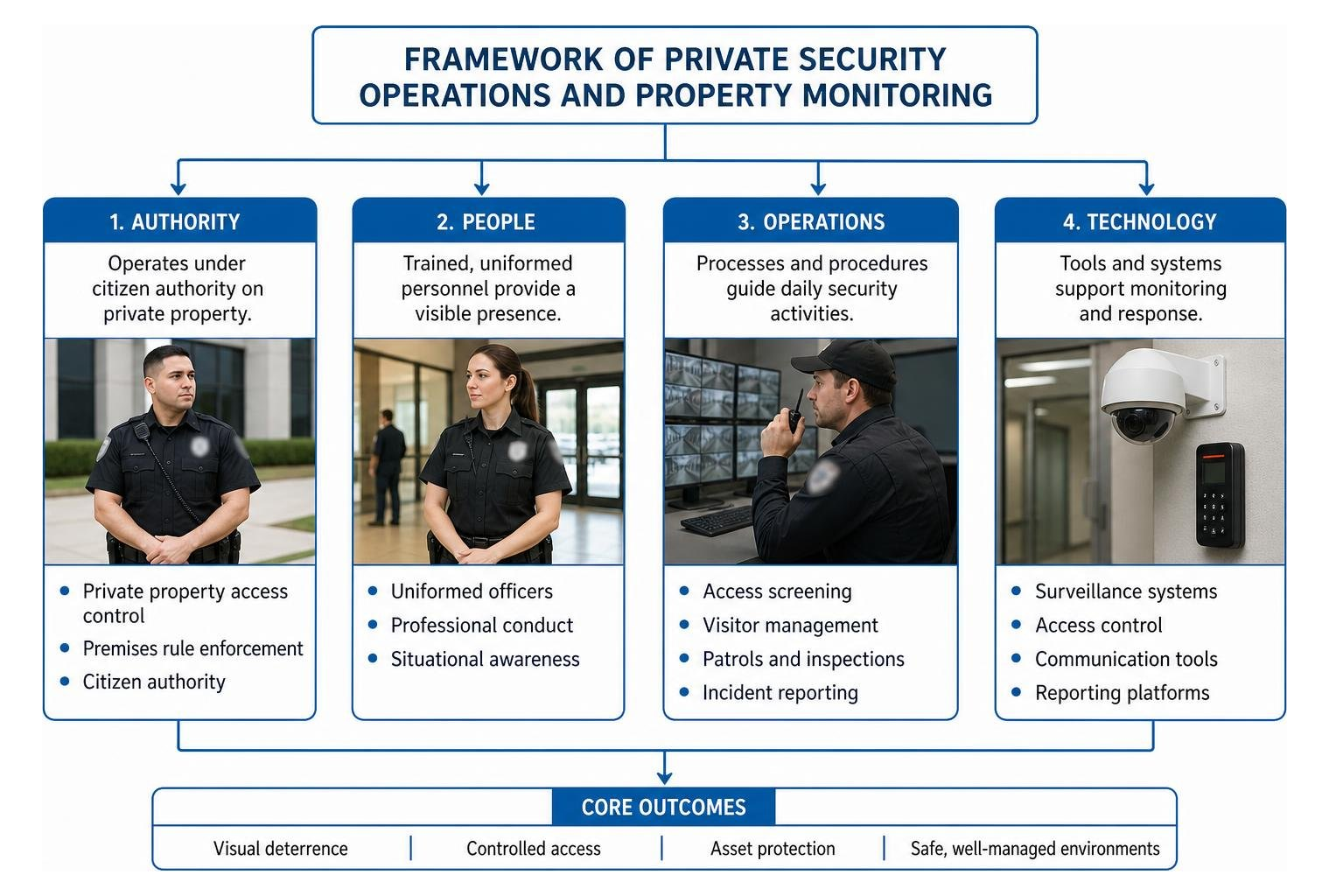
Commercial enterprises deploy uniformed personnel to manage entry desks, inspect visitor credentials, and deter unauthorized activity. Facilities often combine static desk personnel with dedicated mobile teams. For a deeper look at patrol strategies, review this in-depth guide to security patrol services to see how regular physical rounds preserve commercial assets and support property values.
Law Enforcement Hierarchy, Rank Insignia, and Duty Gear Regulations
Every uniformed organization relies on a structured chain of command to maintain operational accountability, ensure command presence, and coordinate emergency responses.
Rank Structure and Chain of Command from Patrol to Chief
In municipal police departments, authority flows downward from executive leadership through mid-level supervisors to field personnel:
- Patrol Officer: The baseline rank responsible for direct public interaction, routine patrols, and primary response.
- Field Detective / Senior Officer: Experienced personnel tasked with specialized casework and detailed administrative reporting.
- Sergeant: First-line operational supervisors who manage patrol squads and direct field operations during active incidents.
- Lieutenant: Shift or sector commanders responsible for supervising multiple sergeants and overseeing facility operations.
- Captain: District or precinct commanders who manage entire facility budgets, staffing assignments, and administrative policies.
- Commander / Inspector: Senior administrators overseeing specialized divisions or geographic bureaus.
- Deputy Chief: Executive leaders directing major operational bureaus.
- Chief of Police / Commissioner: The top executive appointed by city leadership to establish overall department policy.
Advancing through this hierarchy requires meeting time-in-grade standards, passing competitive written promotional exams, undergoing command board interviews, and demonstrating leadership and written communication skills.
Uniform Dress Standards and Seasonal Variations
Agencies use structured uniform classifications to maintain a professional public image across diverse operational environments:
- Class A (Formal / Winter): Long-sleeve shirts, neckties, dress trousers, tailored blouse coats, and formal headgear. Used for ceremonial events, court appearances, and formal details.
- Class B (Daily Duty): Serviceable, high-durability fabrics designed for field comfort, often worn with an outer vest carrier.
- Class C (Utility / Tactical): Rugged tactical uniforms utilized by canine handlers, marine units, and tactical emergency teams.
Seasonal requirements dictate specific transitions. For instance, FR 4-2, Uniforms and Personal Appearance policies for state police establish that summer uniforms are worn from May 1 through September 30, while winter wear runs from November 1 through March 31, with transition windows in April and October. Similarly, municipal directives like the NEW ORLEANS POLICE DEPARTMENT OPERATIONSMANUAL detail insignia placement, collar brass, and mourning band protocols for line-of-duty remembrances. State police agencies operating under a STANDARD OPERATING PROCEDURE also enforce precise guidelines for campaign hats, cord colors, and high-visibility traffic vests during roadside operations.
Duty Belt Equipment Placement and Safety Gear Standards
Equipment must be worn in standardized locations to support rapid access and physical ergonomics. A standard law enforcement duty belt follows a balanced layout:
- Strong-Hand Side: Primary service sidearm secured in a Level III retention holster, mounted weapon light, and secondary baton carrier.
- Off-Hand / Support Side: Conducted Electrical Weapon (CEW), magazine pouch, primary communication radio, and oleoresin capsicum (OC) spray.
- Support Placement: Handcuff pouches positioned along the side, personal tourniquet kits, and high-lumen tactical flashlights.
- Rear Ergonomic Standard: The lumbar spine area between rear belt keepers is kept clear of heavy equipment to prevent nerve and spinal injuries during vehicular seating.
Specialized Units and Professional Training Pathways
Advanced operational roles require rigorous, standardized training curricula to handle complex site scenarios and high-risk environments.
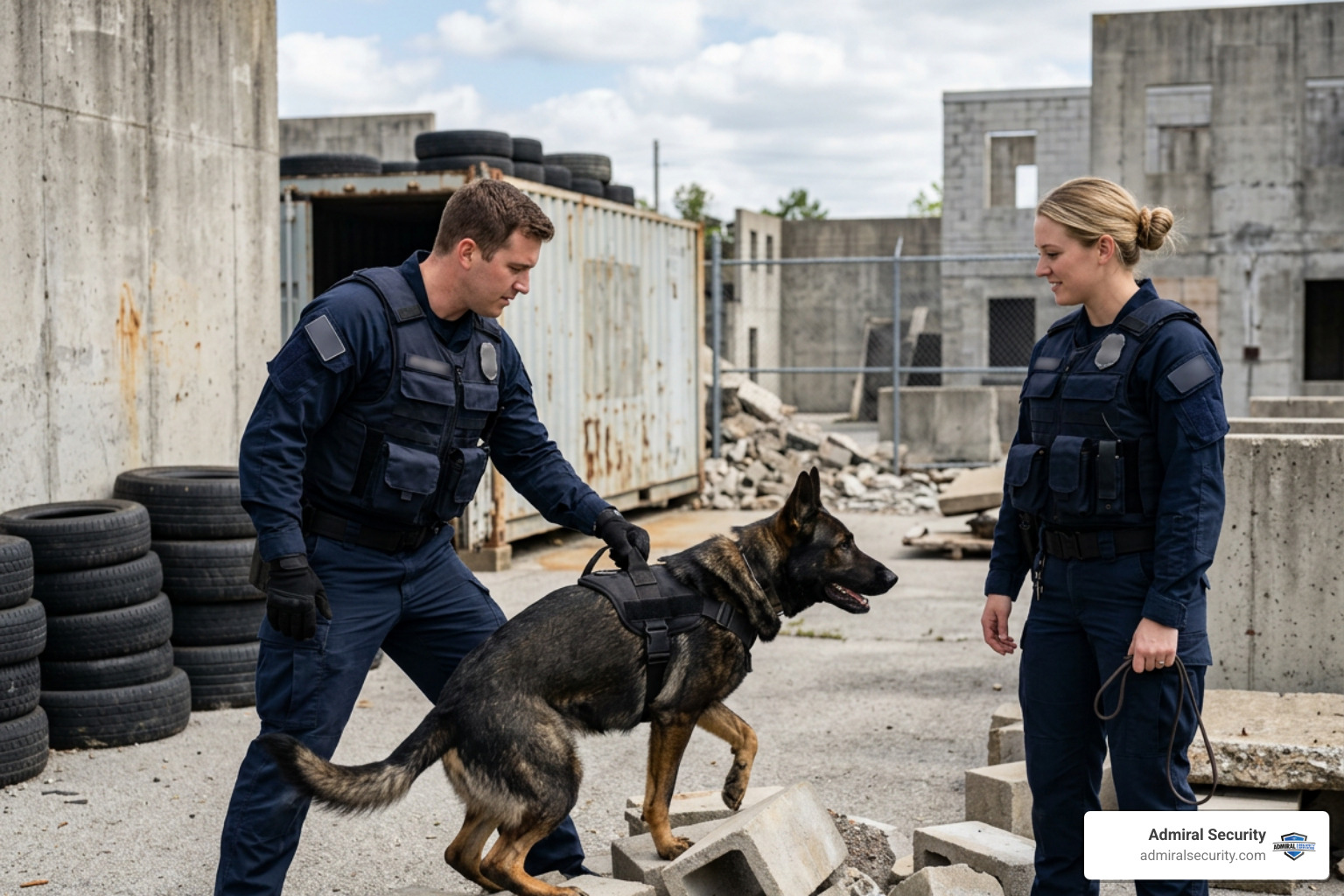
Training Standards and FLETC Modules for Uniformed Officers
Federal uniformed officers complete the Uniformed Police Training Program (UPTP) at the Federal Law Enforcement Training Centers (FLETC). This extensive program spans 64 training days and delivers comprehensive instruction across core domains:
- Legal Studies: Constitutional law, Fourth Amendment search parameters, Fifth and Sixth Amendment rules, federal criminal statutes, and courtroom testimony.
- Behavioral Science: Conflict de-escalation, mental health crisis response, officer resilience, and cross-cultural communication.
- Enforcement & Tactical Operations: Active threat intervention, physical control tactics, vehicle stop procedures, and digital evidence handling.
- Counterterrorism: Physical facility security, Improvised Explosive Device (IED) awareness, and incident command system integration.
- Firearms & Vehicle Handling: Day and reduced-light marksmanship, non-conventional shooting stances, and emergency driving maneuvers.
Elite Specialized Divisions and Tactical Teams
Within major federal and municipal divisions, personnel can advance into specialized operational units:
- Counter Sniper Units: Stationed on designated perimeters to deliver continuous observation and high-precision threat mitigation.
- Emergency Response Teams (ERT): Tactical personnel equipped to resolve barricades, unauthorized entries, and immediate physical threats.
- Canine Operations (K-9): Specialized handler teams trained to detect explosive materials and track unauthorized intruders.
- Motorcade Escort Units: Mobile tactical teams providing vehicular route coordination for domestic leaders and visiting foreign dignitaries.
Career Qualifications and State Certification Pathways
Securing a career as a sworn officer or private security specialist requires completing structured qualification standards:
- Baseline Requirements: Minimum age (typically 20.5 to 21 for sworn law enforcement; 18 for private positions), valid driver’s license, and clean criminal history.
- Background Investigation: Comprehensive background screening, polygraph examination, credit checks, and reference interviews.
- Physical Readiness: Passing standard physical efficiency batteries, including timed runs, agility courses, and push-up evaluations.
- Licensing Requirements: Private personnel must complete certified coursework to become licensed security guards authorized by state regulatory boards.
Frequently Asked Questions About Uniformed Officers
What is the primary role of a Secret Service Uniformed Division officer?
A Secret Service Uniformed Division officer is legally mandated to provide physical security and access management for the White House Complex, the Vice President’s residence at the Naval Observatory, the Treasury Department building, and foreign diplomatic missions located in Washington, D.C.
How do municipal police uniforms differ from private security uniforms?
Municipal police uniforms carry sworn city department badges, city patches, and state-certified credentials denoting municipal law enforcement powers. Private security uniforms display private corporate emblems, state licensing guard patches, and customized corporate apparel designed for clear visual deterrence without mimicking public law enforcement insignia.
What training is required for federal uniformed officers at FLETC?
Federal uniformed personnel undergo the 64-day Uniformed Police Training Program (UPTP) at FLETC. The curriculum covers constitutional law, behavioral crisis management, vehicle dynamics, tactical firearms qualifications, active threat response, and digital evidence preservation.
Conclusion
Uniforms represent visual clarity, disciplined readiness, and professional integrity across every tier of public and commercial service. Recognizing the distinctions between federal divisions, state patrols, municipal precincts, and commercial security teams helps organizations coordinate site safety, optimize access management, and maintain welcoming environments for tenants and visitors.
At Admiral Security, I bring the “Admiral Advantage” to facility security through a blend of authenticity, logic, and empathy. Our trained and dedicated team provides uniformed personnel focused on customer service excellence, responsive access control, and proactive site oversight. Contact our team today to evaluate your facility’s operational requirements and implement a reliable physical security program.